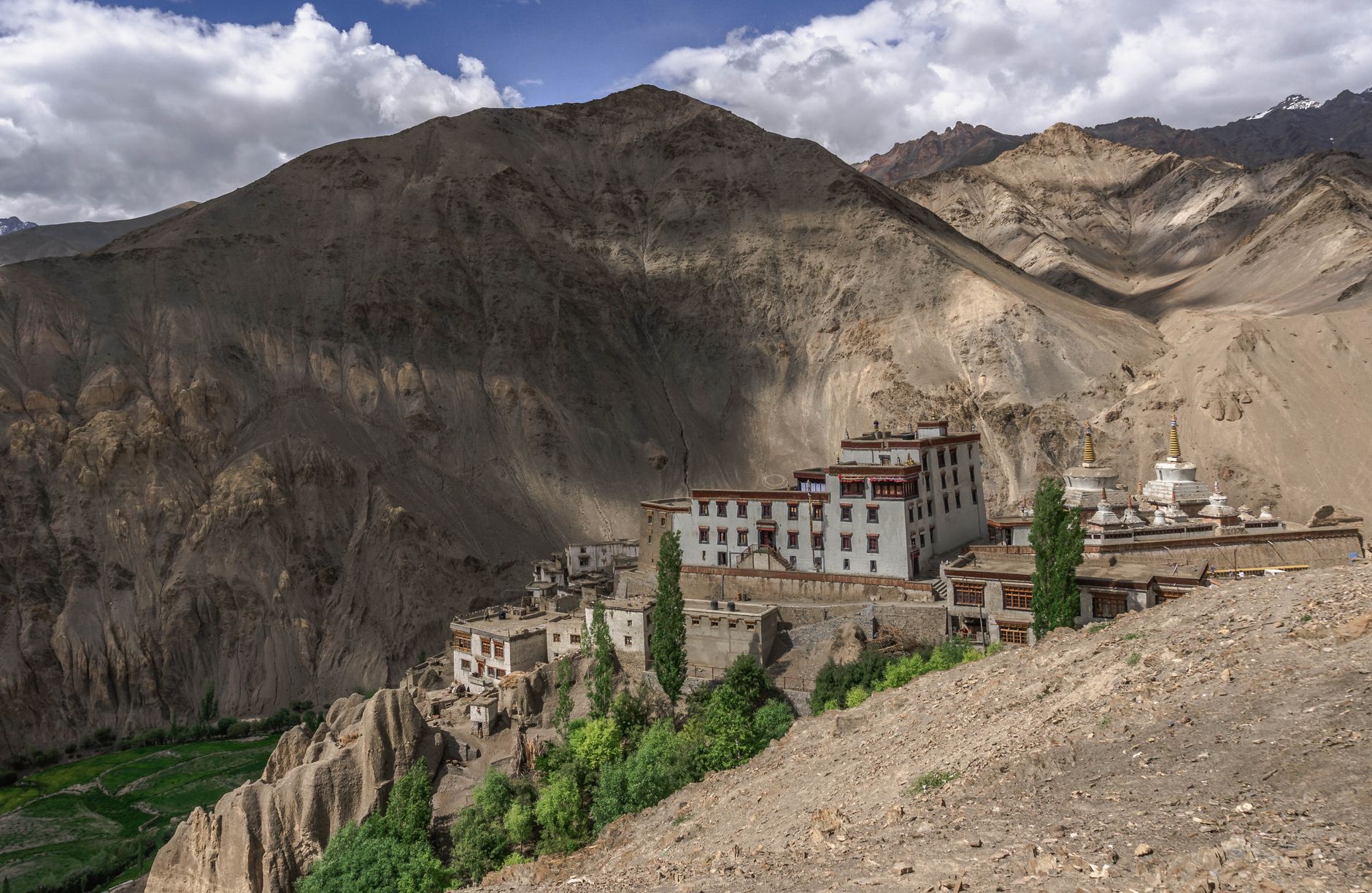
The road ends before the monastery does. That is the first teaching. You leave the car in a gravel pocket shaded by a plane tree, and from there the path climbs — stone, then dirt, then stone again — until the walls appear, pale against the rock, as if the mountain had exhaled them. Greece holds hundreds of these places. Some sit in Meteora’s sandstone pillars, balanced like held breath. Others hide in the folds of Mount Athos, or cling to the cliffs of the Peloponnese, or wait at the end of a switchback road on Naxos. They are not ruins. People live here. They pray here. They have been doing so for a thousand years, and they will likely be doing so long after we have gone home and forgotten the name of the village where we parked.
Silence is not empty. It is full of answers we have not yet learned to hear.
Historical Context
Monastic life in Greece begins in the fourth century, when men and women walked into the desert — first in Egypt, then in Palestine, then in the wild interior of Anatolia and the Greek mainland — seeking a stillness the cities could not offer. The word monachos means “one who lives alone,” though solitude rarely lasted. Others followed. Communities formed. By the tenth century, Mount Athos had become a republic of monks, twenty great monasteries sharing a peninsula, answering to no earthly king. Meteora rose later, in the fourteenth century, when hermits climbed the rock towers and built access only by rope and winch. For centuries, the only way up was a basket. You prayed while you ascended, or you did not ascend at all.
This tradition survived Ottoman rule, world wars, and the slow pull of modernity. It survives still. The monasteries are not museums, though tourists treat them as such. They are living organisms, fed by liturgy, olive oil, and the labor of men and women who chose this. When you enter, you enter someone’s home — one that has been kept for longer than your country has existed.

The Experience
What does it feel like to arrive? The air changes first. It thins. It carries the scent of beeswax and old timber and something faintly resinous — incense, perhaps, or the cypress that grows in the courtyard. Your footsteps sound different on flagstone. The world below grows small and then disappears entirely.
A bell rings. Not a recording, not a chime on a phone. A real bell, pulled by a rope, rung by a hand. The sound travels down the valley and returns a half-second later, softened. Monks move past you without hurry, their black robes brushing the ground. A cat sleeps on a sun-warmed step. Somewhere inside, a voice is chanting in Greek, low and unhurried, and the melody has no beginning you can locate and no end you can anticipate. You sit on a wooden bench. You stop checking your phone. You forget, briefly, that you were ever in a hurry.
The meals are simple — bread, olives, tomatoes, a glass of water. You eat them in silence, or near-silence, listening to the clink of forks and the wind outside. The hours pass in a way you had forgotten hours could pass. Not slowly. Not quickly. Just fully.

Who It’s For
This journey is for the traveler who has grown tired of collecting places and wants, instead, to be collected by one. It suits those who can sit with their own thoughts without reaching for distraction. It suits walkers — people who understand that the best parts of a trip are often the parts that require effort. It suits anyone who has ever stood in a crowded cathedral or a busy temple and felt, somehow, that they were missing the point.
It also suits the quietly curious. You do not need to be religious. You do not need to know the difference between a troparion and a kontakion. You need only to arrive with respect, remove your hat at the door, and let the place do what it has always done.
And here is a counter-intuitive thought: the monasteries are not escapes from the world. They are intensifications of it. You do not go there to forget your life. You go there to see it more clearly, stripped of noise, held up to a light that does not flatter.
Who It’s NOT For
If you need a café on every corner, this is not your path. If your idea of travel is a checklist of photographs, if you measure a day by how many sites you saw, if silence makes you anxious rather than curious — stay in the villages. Stay on the coast. There is nothing wrong with that. The islands are beautiful. The food is excellent. The monasteries will still be here if you change your mind.
Also: this is not a luxury experience. The beds are hard. The bathrooms are shared or nonexistent. The schedule is set by prayer, not by you. Some monasteries admit men only. Some admit visitors for a few hours and no more. You will be asked to dress modestly. You will be asked to leave your loud voice at the gate. If any of that feels like an imposition, honor that feeling. Go elsewhere.
A Profound Insight
Here is what the mountain teaches, if you let it: attention is a form of prayer, and prayer is a form of attention. The monks are not doing something exotic. They are doing something we have forgotten how to do — paying full, unhurried, undivided attention to a single thing. A candle. A psalm. A bowl of lentils. A breath.
You can carry that home. You do not need a cassock or a cliffside. You need only to choose one thing, each day, and give it your whole self for a few minutes. The coffee. The walk to the station. The face of the person across the table. That is the monastery, relocated. That is the practice, portable.
And here is a list worth keeping, if you decide to go:
- Travel light and quietly. One small bag, soft-soled shoes, and clothing that covers shoulders and knees.
- Check opening hours and visitor policies in advance — many monasteries close for midday rest and admit only certain hours.
- Bring cash for donations and small purchases; card readers are rare and unreliable on the mountain.
- Learn three words of Greek: efharistó (thank you), parakaló (please), kaliméra (good morning). They open more doors than any guidebook.
- Leave your phone in your bag. If you must photograph, do so briefly, and never during prayer.
- Sit for at least twenty minutes without doing anything. This is the whole point. The rest is logistics.
The path back down is easier than the climb, which is its own small mercy. You will pass the plane tree. You will find the car. The engine will start, and the radio will blare something loud and urgent, and you will turn it off. Not out of piety. Out of preference. Something in you has recalibrated, and the recalibration will fade, as all things fade, but not entirely. A residue remains. A faint bell, still ringing, somewhere behind the noise. You will hear it again when you least expect it — in a crowded room, in a quiet kitchen, in the pause before sleep. That is the monastery, still with you. That is the mountain, come home.