The call to prayer in Fez arrives before the light does. Five times a day, the muezzin’s voice climbs over the medina’s crooked rooftops. The first one — the fajr, the dawn call — finds you already awake, lying still in a room that smells of cedar and dust. You do not understand the Arabic. You do not need to. Something in you leans toward the sound the way a plant leans toward a window. I have stood at that edge of understanding in a dozen cities now. Each time I learn the same quiet lesson: travel does not hand you faith. It strips away the noise that was hiding the faith you already carried. That distinction matters more than it first appears, because it changes what you pack and what you expect, and it asks you to bring a certain stillness rather than a checklist of holy sites to be ticked off one by one.
Faith is not the absence of questions. It is the willingness to keep walking without the answers.
Historical Context
Pilgrimage is older than any scripture we can name. Before written language, people walked toward the places where the sky felt thin — mountaintops, springs, the mouths of caves. The word pilgrim itself comes from the Latin peregrinus, a stranger, a foreigner, someone who has left the familiar behind. Long before tourism existed as a concept, the act of journeying toward a sacred site was one of humanity’s most enduring spiritual practices. And it was never a solitary act, even when the pilgrim walked alone: the road carried the prayers of everyone who had walked it before, worn smooth into the stones and the stories.
Consider how many traditions built their deepest teachings around movement. The Hajj draws millions to Mecca each year, tracing the path of Hagar and Ibrahim in a choreography that has barely changed in fourteen centuries. Japanese pilgrims walk the Shikoku circuit of eighty-eight temples, following the footsteps of the monk Kūkai. Hindu seekers climb to Kedarnath in the Himalayas, where the air is thin enough to make every breath a prayer. Medieval Christians walked the Camino de Santiago, and the scallop shell still marks the way. The details differ. The gesture is the same. A body, a direction, a destination that promises nothing and gives everything.

What these journeys share is a refusal to separate the body from the spirit. You do not meditate on pilgrimage; you do it with your feet. The geography becomes the teacher. The blister on your heel becomes a lesson in patience. The wrong turn becomes a lesson in surrender. And that is the tradition I carry into every journey I take, whether I am walking toward a shrine or simply boarding a train to a town whose name I cannot pronounce. The scale of the journey matters less than the quality of attention you bring to it. A morning walk to a neighborhood chapel can hold as much devotion as a month on the road, if you arrive with the same open hands.
The Experience
Travel first overwhelms the senses, then quiets them. That is the arc of it, and the arc is where faith lives. Most of us resist the first half. We want the quiet without the overwhelm, the clarity without the noise. But the quiet cannot arrive until the senses have been filled and emptied and filled again, and there is no shortcut through that middle stretch of exhaustion and awe.
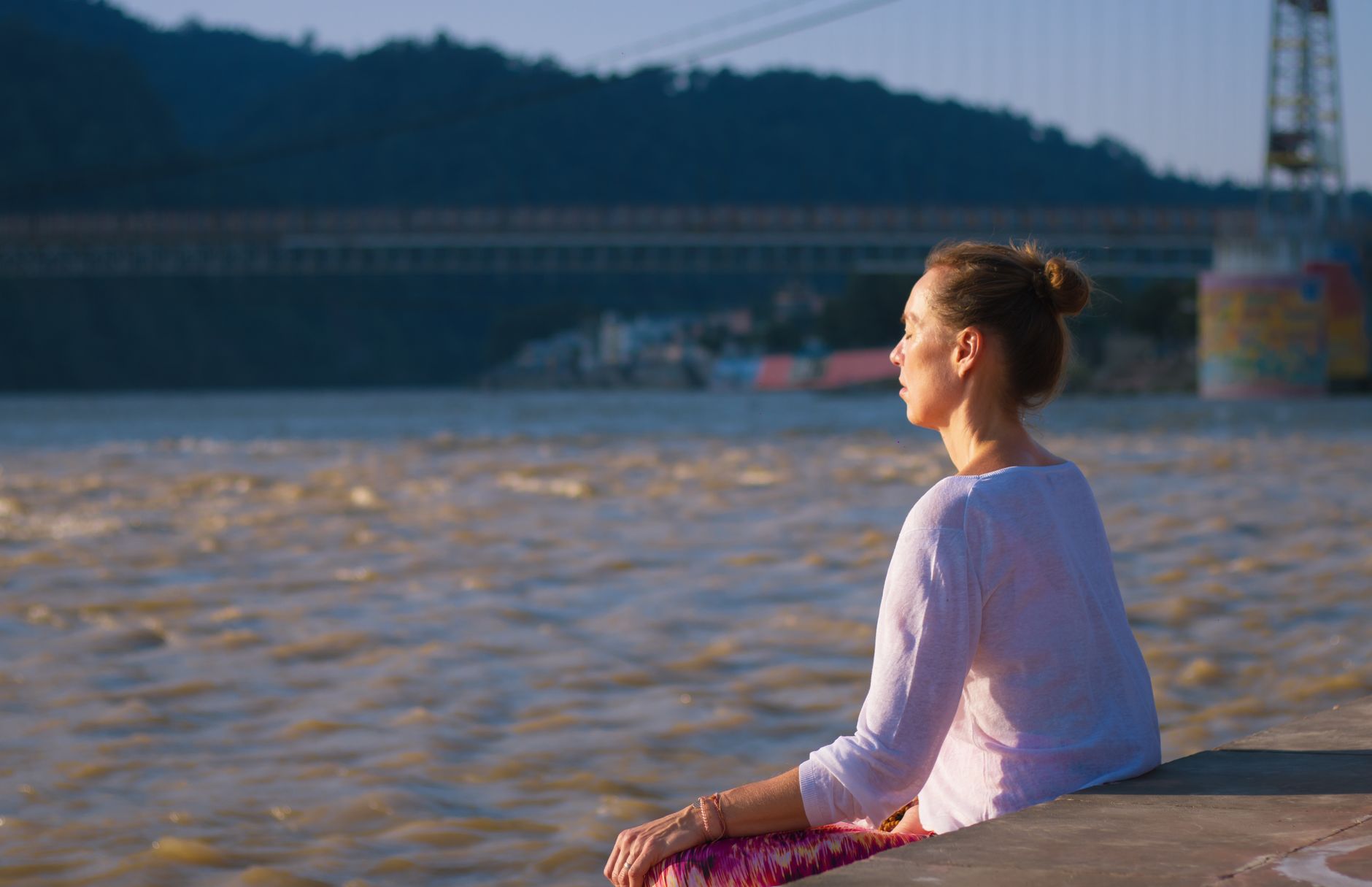
I remember arriving in Varanasi at dusk. The ghats along the Ganges were crowded with bodies, with fire, with the smell of marigolds and cremation smoke. It was too much — the noise, the heat, the grief and devotion pressed together in one long riverbank. I wanted to retreat. Instead I sat on the steps and did nothing for two hours. And slowly, the chaos resolved into a rhythm, like a piece of music you cannot hear until you stop trying to follow the melody. A woman lit a lamp. A boatman called out. A child laughed. By the time the sun rose again, I understood something I could not have learned from a book: the sacred is not the absence of mess. The sacred is the mess, held with attention.
This is what the senses teach when you let them. The cold stone of a cathedral floor under your bare feet. Incense that catches in your throat. The weight of a stranger’s hand on your shoulder during a shared prayer you do not share. Faith, when you travel, becomes physical. It stops being an idea and becomes a texture, a temperature, a sound. It becomes the particular way the light falls through a latticed window at four in the afternoon, and the way you find yourself, without deciding to, sitting down to watch it.
Have you ever noticed how a place can pray without saying a word?
There is a counter-intuitive truth here that took me years to accept: the most spiritually potent moments of travel are rarely the ones at the famous sites. I have stood in awe before the great cathedrals and felt nothing. I have been undone by a plastic chair outside a roadside tea stall in the Atlas Mountains, where an old man poured mint tea and asked, without irony, whether I had known love. The sacred does not announce itself. It arrives sideways, often when you are tired and unguarded and not looking for it at all. The grand architecture can hold you at arm’s length, while a chipped cup and a stranger’s patience let you in.
So the practice is not to chase transcendence. It is to stay available. To keep your eyes open at the wrong moments. To let the journey do its work on you rather than insisting on doing the work on the journey. This is harder than it sounds, because the mind wants to manage the experience, to narrate it, to turn it into something you can report later. The practice asks you to put the narration down and simply be a guest. To arrive without an agenda and to leave without a verdict. The road rewards that kind of humility, and it has a way of noticing when you have brought too much of yourself and not enough of your attention.
Who It’s For
This way of traveling belongs to the seeker who is willing to be uncomfortable in the service of something larger. Not the thrill-seeker, exactly, though there is a thrill in it. Not the ascetic who refuses pleasure, either. The person I am describing is curious and unhurried. They can sit in a mosque courtyard for an hour without taking a photograph. They ask questions they do not already know the answers to. They are willing to look foolish, to mispronounce the names of gods and saints, to be corrected and to laugh. That willingness to be a beginner, again and again, is the single most reliable sign of a pilgrim in the making.
It suits the traveler who suspects that their own tradition — or their lack of one — has more room in it than they were taught. A Catholic who finds something true in a Buddhist monastery. A skeptic who cannot explain why the call to prayer makes them cry. Someone who has stopped trying to resolve the contradictions and has started living inside them instead. There is a particular kind of traveler who carries two or three traditions loosely in their hands and refuses to drop any of them, and this path was made for that person.
These travelers tend to share a few habits. They keep a journal, but a messy one. They walk more than they need to. They return to the same tea house three days in a row because the man behind the counter remembers how they take it. They know that faith, like travel, is built out of small, repeated acts of attention. They are not trying to collect experiences. They are trying to let experiences collect in them, the way rain collects in a bowl left out on a windowsill.
Who It’s NOT For
I will be honest with you, because a good teacher is honest before they are inspiring. This is not for the traveler who needs the sacred to be tidy. If you require a clear itinerary, a guaranteed epiphany, a schedule of spiritual experiences with checkboxes beside them, you will be disappointed. The holy does not keep appointments. It keeps its own hours, and it will not be rushed by a spreadsheet or a list of must-see shrines.
It is not for the person who travels to collect confirmations of what they already believe. If you need every mosque to validate your opinions about Islam, every temple to flatter your assumptions about the East, you are not on pilgrimage. You are on a very long errand. Travel that deepens faith will also disturb it. It will show you the smallness of your categories. It will introduce you to people whose devotion is deeper than yours and whose theology you cannot accept, and it will ask you to sit with that without resolving it. That sitting is the work. The resolution is not.
And it is not for anyone seeking a shortcut around the slow, unglamorous work of their own tradition. A flight to Nepal will not do the inner work that a decade of showing up at your own altar — whatever your altar happens to be — might do. Travel can open a door. It cannot walk you through it. The door stays open behind you when you come home, and what you do with it then is the real pilgrimage, the one that does not end when the plane lands.
A Profound Insight
Here is the idea I would carry home in my open palms, if I could only carry one.
Every tradition I have encountered on the road, from the whirling dervishes of Konya to the quiet Quakers of a meeting house in the Cotswolds, teaches the same counter-intuitive thing: you do not strengthen faith by defending it. You strengthen it by letting it be tested, and choosing it again anyway. Faith is not a fortress to be guarded. It is a garden that grows when you walk through it in all weather. The walls we build around belief keep out the very weather that would make it grow, and the gardener who never leaves the greenhouse learns nothing about the soil.
Travel is one of the fastest ways to test a garden. You are removed from your routines, your community, the small rituals that prop up your belief without your noticing. You are asked to pray in unfamiliar rooms, to sit with doubt in strange languages, to be a guest in someone else’s sacred story. And if your faith survives that — if it comes home quieter and wider and less certain but somehow more alive — then you know it was never just a habit. It was yours. The testing is not a threat to the garden. It is the pruning that lets the light reach the roots.
This is why I return to the road again and again, not to find new gods but to meet my own with fresh eyes. The pilgrimage does not make me more certain. It makes me more willing. And willingness, I have come to believe, is the whole of the practice. Certainty closes the hand. Willingness keeps it open, and an open hand can receive what a closed one cannot even see.
A few things I would tell anyone setting out on this kind of journey:
- Leave room in your itinerary for nothing. The unplanned hours are where the sacred tends to arrive.
- Learn three words in the local language, and use them badly. Humility is a doorway.
- Sit in places longer than is comfortable. Let the first restlessness pass before you leave.
- Keep a messy journal. Write down the small things — the tea, the light, the stranger’s question — not just the grand ones.
- Bring your questions home with you. Do not try to answer them on the plane.
The muezzin in Fez still calls at dawn, whether I am there to hear it or not. That is the comfort of it, I think. The world keeps praying, in a thousand languages, in a thousand rooms, and all we are ever asked to do is listen. Travel simply brings us close enough to hear. The listening is the whole art, and it begins the moment you stop filling the silence with your own voice. So go — not to find faith, but to remember that it was walking beside you the whole time, waiting for you to slow down enough to notice. Pack light. Walk slowly. And when the call comes, from whatever rooftop, in whatever tongue, let yourself lean toward the sound.