The shala floor is still cool at five in the morning. Bare feet find it before the sun does. Beyond the low wall, a rooster begins its argument with the dark, and wet jasmine drifts in from a courtyard you have not yet seen in daylight. You roll out your mat — the same one you carried through two airports and a train — and it lands on stone worn smooth by decades of other feet, other breath. This is the moment yoga tourism rarely advertises. Not the postcard pose on a cliff edge. This quiet, unglamorous arrival into your own body, in a room that has held this practice longer than you have been alive.
“You do not travel to find yourself. You travel to remember what the noise was covering.”
Historical Context
The word “yoga” comes from the Sanskrit yuj — to yoke, to join. For most of its long history, this was never a fitness practice. It was a disciplined path toward liberation, and it lived in ashrams, forests, and caves, taught teacher to student in intimate transmission. Patanjali’s Yoga Sutras offer almost nothing about handstands. They speak of stilling the fluctuations of the mind — citta vṛtti nirodhaḥ — and the physical postures, the asanas, appear as only one small limb of an eightfold path. Breath, ethics, concentration, and deep meditation carry equal weight.
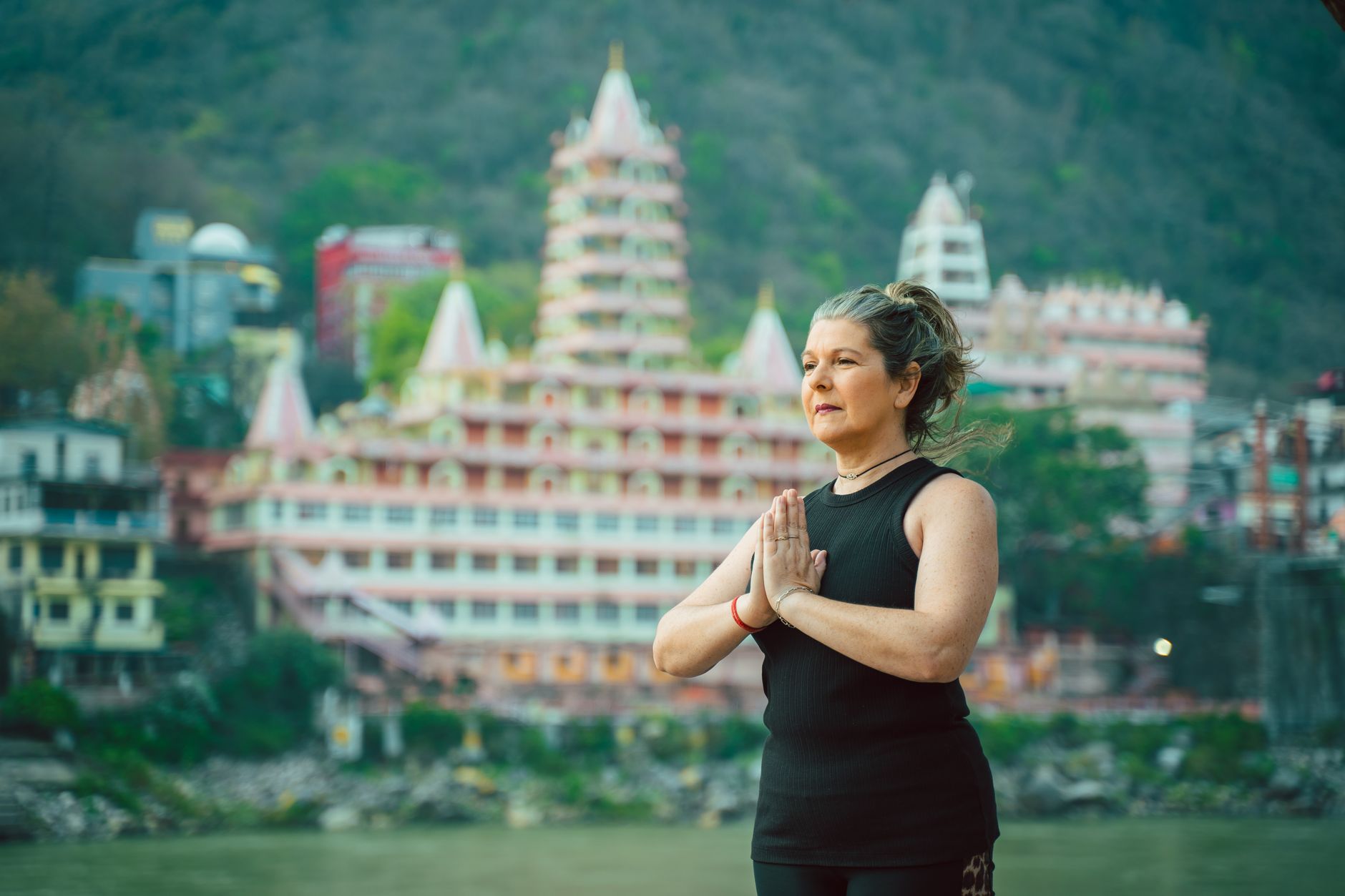
What we call “yoga tourism” is a much younger thing. It grew from two rivers meeting: the twentieth-century export of hatha yoga to the West, and the wanderlust of seekers who wanted to touch the source rather than read about it. Rishikesh, on the banks of the Ganges at the foot of the Himalayas, became the great pilgrimage point — the city where the Beatles came and stayed, and where ashrams, teacher trainings, and riverside shalas multiplied in their wake. Other centers followed their own rhythms. Mysore for the disciplined Ashtanga lineage. Dharamshala for Tibetan stillness. Bali for a softer tropical immersion. Kerala for the healing edge of Ayurveda.

Here is the tension worth holding gently. A tradition built for renunciation now sustains an industry of arrival. That is not automatically a corruption — it is a conversation. The question is whether you come as a guest or a consumer. The tradition can tell the difference, even when the booking page cannot.
The Experience
Practice begins before you are ready. That is the first teaching. The teacher rings a small bell, or simply sits, and the room assembles itself around that silence. You notice things a studio at home never gave you time to notice: the weight of your own ribs, the way your breath arrives slightly ragged the first morning and steadier by the fourth. The floor is hard. Your hamstrings complain. Somewhere a dog barks, no one flinches, and you learn that distraction is not the enemy of practice — it is the material.
By the second week, the rhythm has entered you. You wake before the alarm. You drink warm water. You walk to the shala through streets that smell of frying bread and diesel and, beneath it all, the green mineral breath of the river. The body begins to trust the schedule. Meals become practice too — simple food eaten slowly, without the television, without the scroll. You may find, to your surprise, that you are hungry in a way you have not been hungry in years. Not for food, but for the plainness of a day with edges.
Then comes the afternoon you did not plan. Perhaps a monsoon rain pins you under a tin roof, and you sit for an hour doing nothing at all, and it is the most restful hour of your adult life. Perhaps a fellow student — a stranger from a country you have never visited — says one sentence over tea that rearranges something small and permanent inside you. This is the unadvertised curriculum of yoga travel. Not flexibility. Attention. The slow recovery of your own presence, which no retreat can sell you, because it was never missing.
And yes, there will be discomfort. A teaching that does not land. A teacher whose authority you quietly question. Good. A pilgrimage that never unsettles you has probably not taken you anywhere.

Who It’s For
This kind of travel serves the person who is tired of being a tourist in their own life. You do not need to be flexible. You do not need to stand on your hands. You need only a willingness to be a beginner in public, which is its own quiet courage. The traveller who thrives here tends to arrive with questions rather than answers — someone who suspects the body holds a wisdom the calendar has been ignoring, and who is ready to sit still long enough to hear it.
It suits the early riser and the reluctant one. The person in transition: after a loss, between careers, on the far side of a long effort. The seeker who wants structure without dogma, and community without performance. If you can hold curiosity through a stiff back and a strange breakfast, this practice will meet you exactly where you stand.
Who It’s NOT For
Honesty is a form of care, so let me be plain. This is not for the traveller who needs five-star certainty, a firm itinerary, and air conditioning as a baseline right. Ashram life can be austere. Schedules shift. Hot water is a rumor some mornings. The food will not always agree with you, and neither will the teacher.
It is also not for anyone seeking a quick transformation, a certification as a status symbol, or a photograph that proves something to people back home. And I would gently steer away anyone in acute crisis — deep grief, untreated depression, a body in active injury. A retreat is not a hospital, and a teacher is not a therapist. The container here is real, but it is not clinical. If you need care, seek care. The mat will still be there when you are steadier.
A Profound Insight
Here is the idea worth carrying home, the one that outlasts the tan and the souvenir mala: the retreat is not the practice. The retreat is the doorway. The real work begins the morning after you return, when the alarm goes off in your own bedroom and no bell rings to summon you to the mat. Can you find two minutes of that riverbank stillness in a kitchen that smells of coffee and obligation?
And here is the counter-intuitive part, the one that may surprise you: the goal was never to become calm. Peace is not a destination you fly to and then lose at customs. The practice is the willingness to meet whatever arises — the noise, the ache, the restless mind — without abandoning yourself. You do not travel to a holy place to escape your life. You go so that you might come back and inhabit it more fully.
Keep these close when you plan, and when you return:
- Choose a place by its lineage, not its Instagram — ask who taught your teacher, and for how long.
- Arrive with a question, not an expectation; let the practice answer a different one than you asked.
- Build in unstructured days — the blank afternoons often teach more than the scheduled classes.
- Leave room to be a guest: learn a few words of the local language, buy from local hands, and remember the tradition is not a backdrop.
- Plan your return as carefully as your departure, with one small daily ritual to carry the stillness home.
Travel, at its best, is a form of listening. You go far from home to hear, more clearly, the sound of your own breath — and then you bring that listening back to everyone who shares your ordinary rooms. The shala floor will be cool again tomorrow. The bell will ring. Somewhere, a rooster will argue with the dark. And you, steadier now, will roll out your mat and begin again — not because you have arrived, but because you have finally learned how to stay.