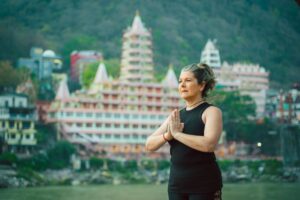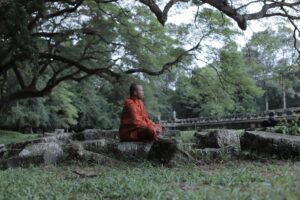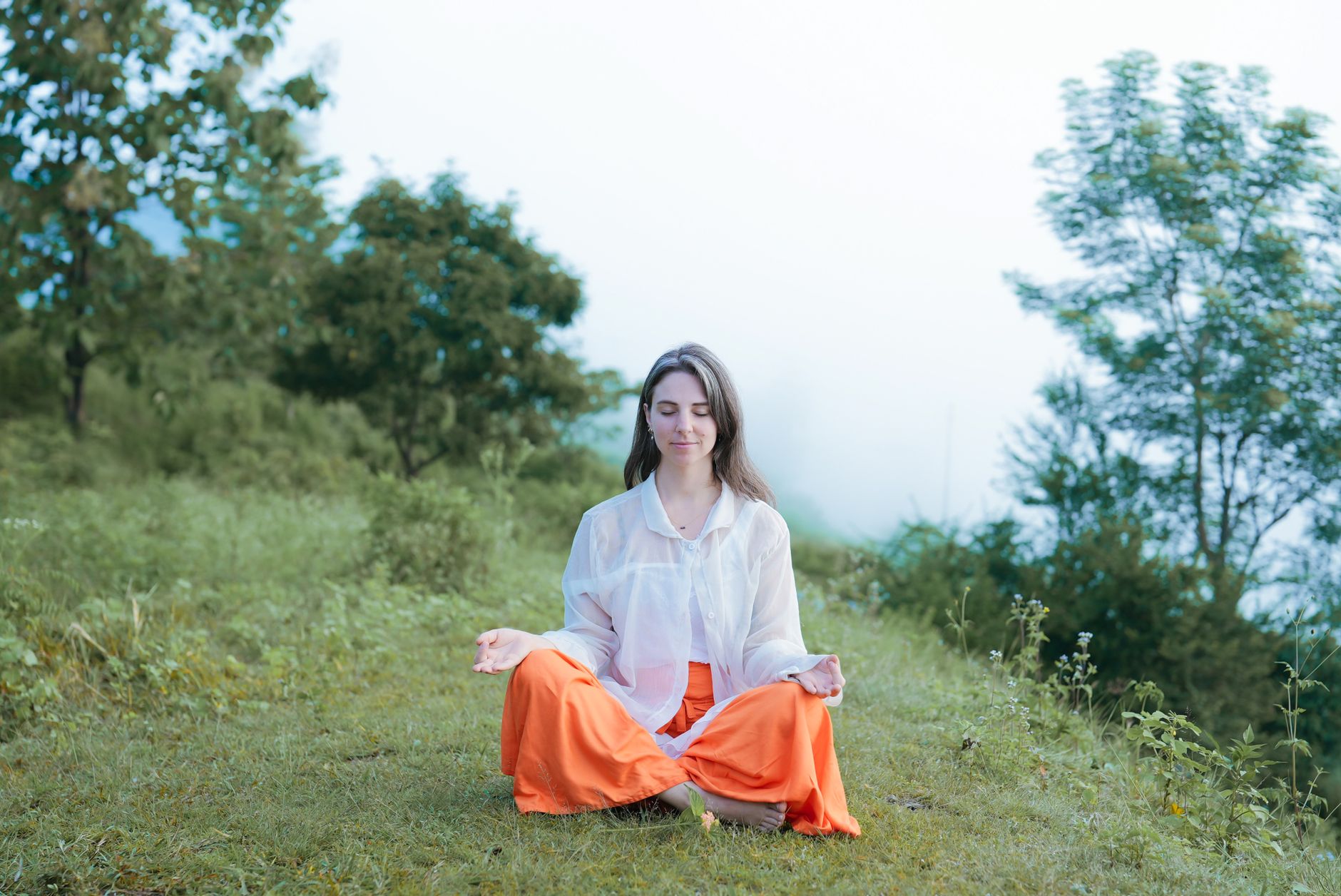
The stone is still warm from the afternoon sun when I sit down. A small beetle crosses my ankle, unhurried. Somewhere above me a bird repeats the same four notes, as if practicing a scale. I have come to this hillside not to hike it, photograph it, or conquer it, but to listen. Meditation with nature is an old practice wearing new clothes. It asks nothing of the landscape except permission. And yet, the moment I close my eyes, the forest seems to lean closer, offering its sounds like a handful of seeds. I breathe in pine and dust. The thinking mind softens. This is where the practice begins.
“The forest is not a place to escape to. It is a place to arrive.”
Historical Context
Long before meditation studios had cork floors and app subscriptions, people sat under trees. The Buddha awakened beneath a bodhi tree, but he was not the first to seek stillness in the wild. The Upanishads, composed in the forests of ancient India, were literally called aranyaka—”forest texts”—teachings meant to be whispered among roots rather than recited in courtyards. In Japan, Shinto practitioners walked mountain paths to feel the presence of kami, the spirits dwelling in rock and waterfall. Native American traditions across the continent treated the natural world not as a backdrop for prayer but as the prayer itself. The desert fathers of early Christianity withdrew to scrubland silence. Sufi wanderers listened to wind as the breath of the divine.
What these traditions share is a refusal to separate the sacred from the soil. Meditation with nature is not a modern wellness invention. It is a return. The nineteenth-century naturalist John Muir wrote that “in every walk with nature one receives far more than he seeks,” and he meant it as a spiritual accounting, not a recreational one. When we sit outdoors with intention, we join a lineage of seekers who understood that the mind quiets more easily when the world is allowed to be louder than our thoughts.

The practice has taken new shapes in recent decades. Forest bathing, or shinrin-yoku, emerged in Japan in the 1980s as a public health response to urban stress. Researchers measured lowered cortisol, reduced blood pressure, improved immune markers. But the Japanese foresters who championed it never pretended to invent something. They were reviving an older knowing—that trees heal, that stillness outdoors is medicine. I find this history comforting. It reminds me that I am not trying something experimental. I am remembering something my ancestors never forgot.
The Experience
Here is what actually happens when you sit with a landscape for twenty minutes.
First, the body complains. Damp seeps through your trousers. A mosquito finds the soft skin behind your ear. Your lower back aches in a way it never does on a cushion. This is not failure. This is the body announcing itself, the way a dog barks when someone arrives. Stay. The complaints fade into a rhythm.
Then the ears take over. The visual world—the one you usually trust most—becomes background. What rises instead is a symphony of small sounds: the tick of leaves colliding, the distant argument of crows, water moving somewhere you cannot see. Each sound arrives without asking permission and leaves without apology. You begin to notice that you are not listening to nature. You are listening as nature, your own breath joining the chorus. There is a moment—brief, ungraspable—when the boundary between inside and outside thins to a membrane. The forest breathes through you. You breathe through the forest.
Smell becomes intimate in a way it never is indoors. Wet bark. Crushed mint. The mineral coolness of a stream. Taste: the metallic tang of mountain air, the sweetness of a blackberry you did not pick but remember. Touch: rough granite, soft moss, the surprising warmth of a sunlit stone against your palm.
And then there is the silence beneath the sounds. Not an absence but a presence. A spaciousness that feels less like emptiness and more like being held. I have sat in meditation halls for years and found this silence only intermittently. Outdoors, it arrives more readily, as if the world itself is a teacher who has been waiting for me to stop talking.
What does it feel like? Like remembering a language you spoke as a child. Like the relief of setting down a heavy bag you forgot you were carrying.

Who It’s For
This practice serves the traveller who is tired of collecting places and wants to be collected by one. If you have ever felt a pang of guilt at rushing through a national park with a camera and a checklist, this is for you. If your meditation practice has become stale—too many cushions, too many apps, too much striving—the outdoors will loosen its grip on you.
It suits the restless beginner who cannot sit still in a quiet room but can walk a forest path with attention. It suits the grieving, the burned out, the recently heartbroken—people for whom the natural world offers a companionship that human words cannot. It suits the traveller who wants to arrive somewhere and actually feel it, not just post proof of arrival.
It suits anyone willing to be uncomfortable for twenty minutes in exchange for a quieter mind. The practice asks for patience, not fitness. You do not need special gear. You need a willingness to sit on the ground and let the ground sit with you.
Who It’s NOT For
Let me be honest about the boundaries.
This is not for the traveller who needs certainty and schedule. Nature does not perform on cue. The meditation you planned may be interrupted by rain, by a barking dog, by a group of teenagers with a Bluetooth speaker. If unpredictability destabilizes you rather than frees you, a guided indoor practice will serve you better.
It is not for anyone in acute crisis without support. Nature can hold grief, but it cannot replace a therapist, a friend, or medical care. The forest is not a substitute for human help. I have seen well-meaning teachers imply otherwise, and it troubles me.
And it is not for the traveller who wants to be seen meditating. If your practice depends on an audience—even a digital one—the trees will not cooperate. They do not care about your stillness. They care about their own. That indifference is the gift, but it is also the test. Ask yourself honestly: can you sit without being witnessed?
A Profound Insight
Here is the idea I carry home from every landscape: attention is a form of belonging.
We tend to think belonging comes from ownership—the passport stamp, the reservation, the photograph that proves we were there. But the forest offers a different arithmetic. The more carefully you attend to a place, the more that place attends to you. Belonging is not granted by geography. It is earned by presence.
This is counter-intuitive in an age that treats travel as accumulation. We believe we must go farther, higher, more remote to find the sacred. But I have had my most profound meditative moments in a city park, on a suburban walking trail, beside a drainage ditch that happened to catch the evening light. The wild is not a destination. It is a quality of attention. You can find it in a potted basil plant on a windowsill if you sit with it long enough.
Carry this home: you do not need to travel to the ends of the earth to meditate with nature. You need to travel the short distance from your thinking mind to your senses. The forest is always closer than you think. It begins at the edge of your skin.
There is a corollary that unsettles some people. If attention is belonging, then the most “spiritual” place is not necessarily the most beautiful one. It is the one you have learned to see. This reverses the logic of the bucket list. The pilgrim who sits for an hour beside a single oak may receive more than the tourist who photographs a hundred waterfalls. Depth is not measured in miles. It is measured in minutes of genuine presence.
Practical Guidance
Before you go, a few recommendations drawn from years of sitting on cold ground and learning the hard way:
- Sit for at least twenty minutes. The first ten are usually restless. The practice begins when the restlessness exhausts itself.
- Choose one sense to anchor on. Sound is often easiest outdoors. Let the ears lead; the eyes will follow.
- Leave the phone behind, or at least silenced and out of reach. A single notification can shatter a fragile stillness.
- Return to the same spot more than once. Familiarity deepens attention. A place you visit three times will teach you more than three places you visit once.
- Close with gratitude—spoken or silent. Thank the ground you sat on. It is a small gesture that completes the circle of attention.
And one more: resist the urge to make the experience useful. The mind will try to turn your stillness into content, a lesson, a story. Let it be useless. Let it be nothing but what it is. The most profound moments outdoors are the ones that refuse to become anything else.
So here is my question for you, traveller: when did you last sit somewhere wild and let it sit with you, without a plan, without a photograph, without a reason? The answer may tell you more about your relationship with the living world than any itinerary ever could. The trees are not going anywhere. They are waiting, patient as always, for you to stop moving long enough to notice them. The stone is still warm. The beetle has moved on. The bird is still practicing its four notes. Sit down. Listen. The forest has been holding this seat for you.