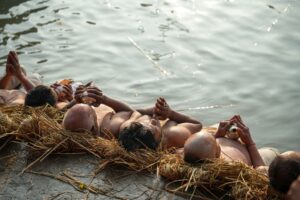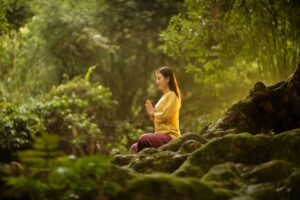
The train from Rishikesh to Haridwar rattled so hard my pen jumped off the page three times. I gave up and watched the Ganges slide past the window, silver in the early light. I had carried a small notebook for years by then, but that morning it felt like a demand rather than a companion. Somewhere between the third bump and the fourth, I understood something I have shared with every traveller I have guided since. Gratitude on the road is not a discipline of writing more. It is a discipline of noticing first. The journal is only the vessel. The attention is the practice.
Attention is the rarest and purest form of generosity.
Historical Context
The gratitude journal as we know it is a surprisingly young object, though the impulse behind it is ancient. In the West, the practice gathered momentum in the 1990s and 2000s, when psychologists began studying what contemplatives had long claimed: that deliberately naming what is good reshapes the one who names it. Before that, the daily accounting of gifts lived inside prayer books, monastic rules, and the small ledgers that devout households kept to mark blessings received. The form changes. The gesture does not.
Travel writing carries its own lineage of thanks. Pilgrims crossing the Camino de Santiago have kept route journals for centuries, and many of those pages read less like maps than like litanies — bread given, a stranger’s directions, a bed for the night. In Japan, the practice of naikan, a structured reflection on what one has received from others, has been used for generations as a way of restoring perspective. And in India, where I first learned to travel slowly, the morning ritual of sankalpa — a quiet intention set before the day begins — is followed naturally by a moment of acknowledgment for what has already been given. None of these traditions call themselves gratitude journals. All of them practise the same muscle.

What strikes me is how often the practice was communal before it was private. The modern notebook is a solitary object, but the older forms were spoken aloud, shared at a table, offered as a small ceremony. That matters for travellers. We are, by definition, away from our people. A journal can become a substitute for the shared table, or it can become a way of remembering that the table is still there, waiting.
The Experience
Here is what it actually feels like, on a good morning. You wake in a room that is not yours — the light falls at an unfamiliar angle, the street below has its own rhythm, someone is frying something that smells of cardamom and ghee. You are tired and slightly disoriented. You reach for the notebook, and for the first three minutes nothing comes. The pen hovers. The mind offers complaints instead: the mattress, the noise, the plan that fell apart yesterday.
Then you write one true thing. The woman at the chai stall remembered my order. And something loosens. The second line arrives more easily. By the fifth, you are not describing a perfect day — you are describing a real one, and finding that the real one had more in it than you noticed at the time.
Do this for a week on the road and the quality of your days changes. Not because the days improve, but because your instrument does. You begin to catch moments as they happen, knowing they will be written down. The practice moves backward into the day. A slow meal becomes a sentence before it is finished. A kindness from a bus driver gets filed away while it is still warm. The journal stops being a record and becomes a way of travelling — a second set of eyes that never quite closes.
There are hard mornings too. Some days the honest entry is thin and grey, and the discipline is to write it anyway without forcing a silver lining. Gratitude that cannot hold a difficult day is not gratitude. It is performance. The practice matures when you can write, in the same breath, what was heavy and what was quietly good, and let both stand.
One more thing the body learns: the pace of the hand. Writing by hand slows the mind to the speed of ink. On a train, in a café, on a stone step at dusk, the pen becomes a small anchor. I have watched travellers arrive at their notebooks breathless and leave them calm. The page does that. It asks you to sit still long enough to mean what you write.

Who It’s For
This practice serves the traveller who feels the days blurring together — the one who takes hundreds of photographs and remembers almost none of the moments behind them. It suits the slow traveller, the walker, the pilgrim, the person who has chosen a long stay over a long list. It is a gift to anyone prone to the particular loneliness of the road, that strange ache of being surrounded by life and slightly outside it.
It also serves the anxious traveller. The mind that rehearses disasters at 3 a.m. in an unfamiliar city can be given a gentler task. Naming three received gifts does not erase fear, but it widens the room fear has to stand in. I have seen this work in hostel dorms and monastery cells alike.
And it serves the traveller returning home. The entries written abroad become a map of who you were becoming while you were away — a record you will read a year later and barely recognise, in the best way.
Who It’s NOT For
Let me be honest about the boundary. This practice is not for someone in the middle of a crisis who needs rest, not reflection. If you are grieving, ill, or simply exhausted, the last thing you need is another daily obligation dressed as wellness. There is a time for the notebook and a time for sleep.
It is also not for the traveller who wants a system to optimise. If your instinct is to build a template, track streaks, and grade your entries, the journal will become one more performance to maintain — and the road already asks enough of you. Nor is it for anyone who feels pressured to feel grateful on schedule. Forced thankfulness curdles. Better to skip the page than to lie on it.
If any of that sounds like you, put the notebook down. The noticing does not require the writing. Watch the morning instead. That counts.
A Profound Insight
Here is the idea I would carry home, and it runs against the grain of most gratitude advice: the entry that matters most is rarely the one about the beautiful thing. It is the one about the ordinary thing you almost missed.
The sunset writes itself. The mountain writes itself. These are easy gifts, and they ask nothing of us. The practice deepens when it turns toward the unremarkable — the vendor who waved you through the crowd, the stranger who held the door, the silence of a courtyard at noon. Gratitude aimed only at the spectacular becomes a kind of consumption; we collect beautiful moments the way we collect photographs. Gratitude aimed at the ordinary becomes a form of attention, and attention is what changes a traveller into a guest.
I have come to think of the notebook as a small act of humility. It says: I did not make this day alone. Someone fried the cardamom. Someone drove the bus. Someone let me sit on their step. To write these down is to keep the ledger of our dependence, and to keep that ledger is to stay human on the road.
- Write three true things, not three impressive things — the ordinary entries carry the most weight.
- Keep the notebook small and always within reach; a pen that lives in your pocket beats a beautiful one at the bottom of your bag.
- Let hard days onto the page without forcing a lesson; gratitude that cannot hold difficulty is only performance.
- Read the entries aloud once a week, ideally to someone — the practice began as a shared table, and it stays alive when shared.
- Carry the habit home. The road teaches the muscle; the return is where it gets used.
The train reached Haridwar before I finished that first page, and I remember closing the notebook without writing anything more. The river had done the teaching that morning, and the pen was simply there to witness it. Years later, I still keep a small book in my bag, and I still miss days. That is the practice — not perfection, but return. On your next journey, take a notebook and a pen that fits your hand. Then take the harder thing: the willingness to sit for four minutes and notice what has already been given. The road will offer more than you can record. Write down a little of it. The little is enough.