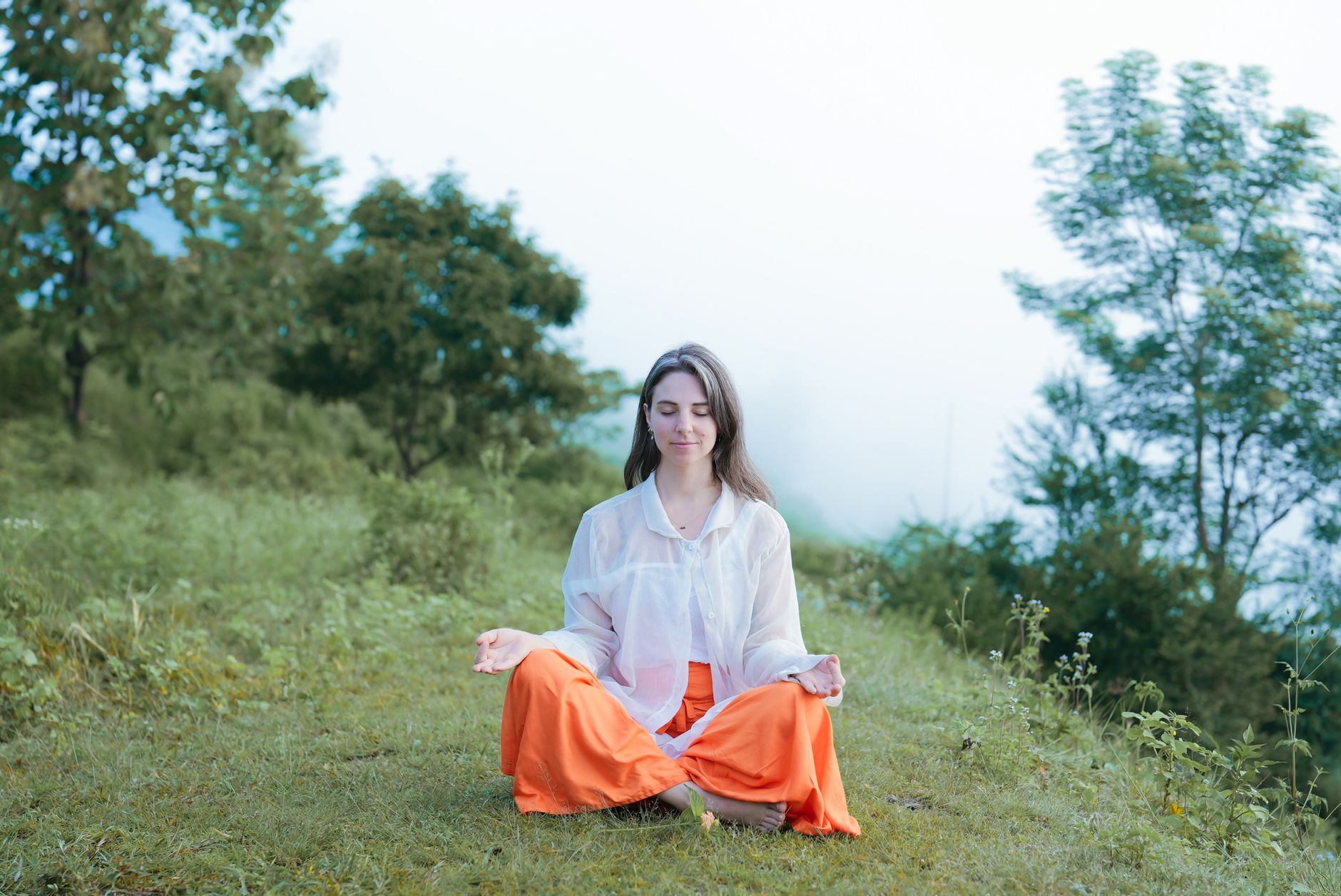
You are standing in a room that is not yours. The bed is strange. The light falls at an unfamiliar angle, and somewhere down the hall a door closes with a sound you do not recognize. Everything is new, and that is precisely the trouble. Before you sleep, before you go out to meet the city, you reach into your bag and lift out three small things: a stone from a river you once sat beside, a stub of candle, a folded square of paper with a name written on it. You arrange them on the windowsill. The room changes. Not the room — you do. This is a travel altar, and it takes almost no space at all.
Wherever the feet wander, the heart needs a place to kneel.
Historical Context
The practice of carrying the sacred with you is older than most maps. When the Israelites moved through the desert, the Ark of the Covenant traveled ahead of them — a portable dwelling for the divine, built to be dismantled and carried on poles. The Romans kept small figures of their household gods, the Lares, in shrines called lararia, and soldiers on campaign carried miniature versions in their packs. In Japan, the kamidana — a small shelf holding a shrine — sits high in homes and shops, and travellers have long kept simpler versions tucked into their luggage. Hindu households place a small puja corner wherever the family settles, even in rented rooms far from home. Buddhist practitioners the world over carry a mala, a tiny image, a printed sutra. The pattern repeats across cultures because the need repeats across hearts: when the outer world will not hold still, we build an inner room and furnish it with the things that remind us who we are.
What we call a travel altar is the modern, unaffiliated descendant of these traditions. It borrows without claiming ownership. It asks no priest and follows no single rulebook. It simply says: I am here, and I am paying attention.

The Experience
Unpacking the altar is a ritual in itself. You do it slowly. You do not toss the objects onto the nightstand the way you toss your charger. You find a surface — a corner of a desk, the lip of a sink, the top of a small fridge — and you wipe it clean with your palm. No incense burns. No bells ring. There is the sound of your own breath, the faint hum of a hotel air conditioner, the distant clatter of a city you have not met yet.
The first object you place is usually the one that weighs nothing but carries the most. A photograph of someone you love. A ring that belonged to your grandmother. A shell you picked up on a beach the morning you decided to leave a job that was slowly erasing you. You set it down and something in your chest loosens. Then the second object — maybe a candle, maybe a small bowl. And the third, which is often nothing more than a piece of paper where you have written a single word: breathe, or trust, or a name you are trying to forgive.
The altar does not need to be beautiful. It needs to be seen. You will pass it a dozen times a day — on your way to the bathroom, on your way out the door, on your way back in at midnight with your shoes in your hand. Each time, your eyes land on it and something small happens. A reset. A remembering. It is not magic in the way a spell is magic. It is magic in the way a well-worn path through a field is magic: you keep walking it, and it keeps leading you back to yourself.
Some travellers light a candle. Others leave a glass of water overnight and pour it out in the morning as an offering. Some sit for five minutes before they leave the room; some simply touch the stone as they pass. There is no wrong way. The only requirement is that you return to it. An altar you ignore is just clutter with a story.

Who It’s For
This practice is for the traveller who feels unmoored after the third night in a new bed. For the one who wakes at 3 a.m. in a time zone that does not belong to them and cannot remember, for a disorienting second, what city they are in. For the person who loves the road but also loves the quiet anchor of a familiar object — a mala, a deck of cards, a small statue of Ganesha who has ridden in carry-on luggage across four continents.
It is for the solo traveller, especially. When no one is waiting for you at the end of the day, you must become your own witness. The altar becomes a small ceremony of self-acknowledgment. You are here. You have arrived. You are not lost, even if you do not know the name of the street.
It is also for the traveller in grief. When you lose someone and then leave home — for a retreat, a pilgrimage, a trip you booked before the loss — the altar gives you a place to put the weight. A candle for them. A photo. A line of poetry they loved. You do not have to carry the whole grief through the airport. You can set a piece of it down on a windowsill in Lisbon and sit with it there.
And it is for the traveller who is not religious at all. You do not need to believe in anything to benefit from a small, deliberate arrangement of meaningful objects. You only need to be willing to pause. The altar is a question you ask yourself each day: what matters right now?
Who It’s NOT For
This is not for the traveller who wants a system. If you are looking for a precise set of rules — the correct number of objects, the correct order, the correct prayer — you will be frustrated here. The travel altar resists codification. It is deliberately loose because it must fit into a backpack, a hostel locker, a tent, a train compartment. The moment it becomes a checklist, it stops working.
It is also not for the traveller who is running. If your trip is a frantic attempt to outrun something — a heartbreak, a diagnosis, a version of yourself you cannot bear — the altar will not help you escape. It will do the opposite. It will slow you down. It will ask you to sit with what you brought. That is not always what you want on a holiday. Sometimes you want the beach and a cocktail and no interior weather at all. That is allowed. Not every journey needs an altar. Some journeys need a nap.
And it is not for the traveller who has no privacy. If you are sharing a room with six strangers in a hostel dorm, you may not have a surface to call your own. In that case, the altar lives inside you — a mental image, a mala worn under your shirt, a stone in your pocket that your thumb finds without thinking. The form changes. The practice remains.
Here is a counter-intuitive opinion: the most powerful travel altars are not the elaborate ones. They are the ones with three objects or fewer. Abundance dilutes attention. When you have twenty sacred items, none of them is sacred. When you have two, each one carries the full weight of your devotion. Pack light. Pack meaning.
A Profound Insight
The altar teaches you something that no guidebook can: home is not a place you return to. It is a practice you carry. Every time you unpack your small objects and arrange them on an unfamiliar surface, you are rehearsing a truth that most of us spend a lifetime forgetting — that belonging is not granted by geography. It is created by attention. You do not need to find a sacred place. You need to make one, again and again, wherever you land.
This is why the altar matters more on the road than it does at home. At home, the whole house is the altar. The familiar mug, the creaky floorboard, the neighbour’s dog — they all hold you without your noticing. On the road, you must hold yourself. The altar is the visible proof that you are doing it. It is a small, stubborn declaration: I am here, and I am not scattered. I have gathered myself into three objects and a square of light on a windowsill.
What would you place on your altar if you had to choose only three things? Not the most valuable things. The most true ones. The ones that would remind you, on a disorienting morning in a city whose language you do not speak, that you are still you. Answer that question honestly and you will have everything you need to build one.
- Choose three objects or fewer — a stone, a photo, a written word — and let each one carry full meaning rather than many carrying none.
- Find a clean, quiet surface in your room and arrange them deliberately, the way you would set a table for someone you love.
- Return to the altar at least once a day, even for ten seconds, so it becomes a living practice rather than forgotten clutter.
- Adapt the form when privacy is scarce — a mala under your shirt, a stone in your pocket — but keep the ritual of pausing.
- Let the altar hold what you cannot carry alone: grief, intention, gratitude, or the simple wish to stay awake to your own life.
You will leave this room in a few days. You will pack the stone, the candle stub, the folded paper, and you will place them back in the small cloth bag you keep for exactly this purpose. The windowsill will be empty again, and someone else will sleep here, and they will never know that for three nights this corner of the world was a temple. That is the quiet beauty of it. The altar is not for the room. It was never for the room. It is for the one who built it, and who now walks out the door a little more gathered, a little more whole, ready to meet whatever the road has been saving for them.