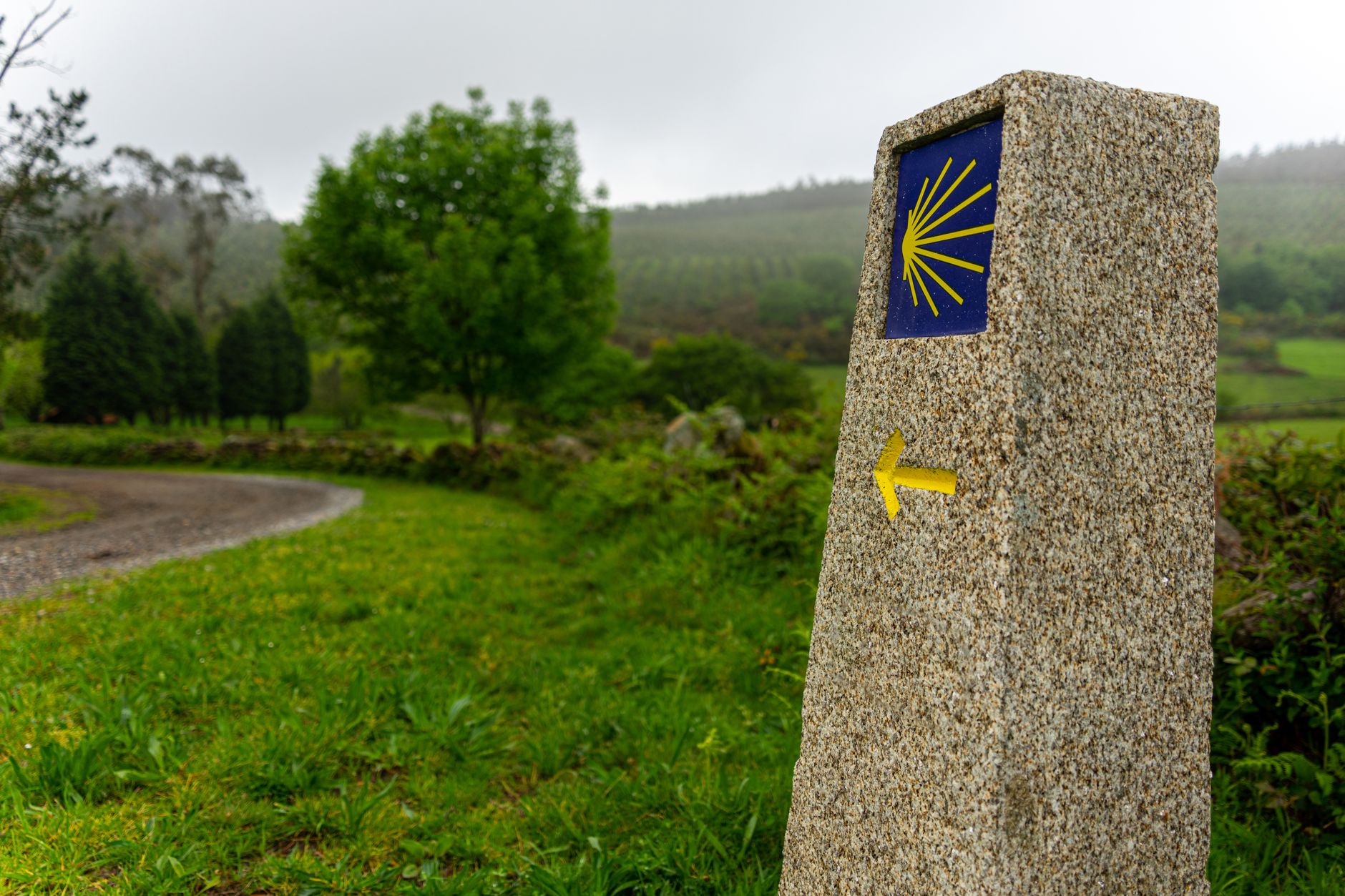
A low, weathered stone marker appears just past the edge of Saint-Jean-Pied-de-Port, its scallop shell worn smooth by a thousand hands. Fog hangs in the beech trees. Somewhere ahead, a cowbell sounds, then fades. I stood there a long moment, boots still stiff, pack still strange on my shoulders, and felt the odd weight of a beginning already begun by countless others. The Camino de Santiago does not ask whether you are ready. It extends the path, one yellow arrow at a time, and waits to see what you will do with your feet.
“The road teaches what the destination cannot.”
Historical Context
The Camino de Santiago is older than most of the nations it crosses. Its roots reach back to the ninth century, when the tomb of the apostle James — Santiago — was said to be found in what is now northwestern Spain. A shepherd, guided by a star, found the field where the remains lay. The Latin Campus Stellae, field of the star, is one of the folk etymologies that gave Santiago de Compostela its name. From that discovery grew one of the great pilgrimage routes of medieval Christendom, drawing the faithful from every corner of Europe toward a single cathedral on the Atlantic edge of the world.
In the Middle Ages, the Camino was no leisure path. It was a corridor of devotion, commerce, and mercy. Kings built bridges. Monastic orders founded hospitals. Villages grew because pilgrims needed bread, a bed, a blessing. The route knitted French, Basque, Castilian, and Galician lands into something like a shared nervous system. Then came the Reformation, the plague, the slow decline of pilgrimage across Europe, and for centuries the path thinned to a whisper.

The revival is recent and remarkable. In the 1980s, a handful of walkers arrived each year in Santiago. Today, hundreds of thousands receive the Compostela certificate annually. The Camino has become many things at once — a Catholic pilgrimage, a secular walking holiday, a grief ritual, a gap-year cliché, and a genuine spiritual practice. Its genius is that it holds all of these without demanding you choose. The path does not screen its pilgrims.
The Experience
What does it actually feel like? Begin with the body, because the body is the first teacher. Within three days, your feet become a subject of constant conversation — blisters, heat, the particular ache of the shin muscle on a long descent. You learn to read weather in the color of the sky over the meseta. You learn that a 25-kilometer day is not a distance but a mood, an entire small lifetime between sunrise and the first beer in the plaza.
The silence is not what you expect. It is not empty. Walk alone through the oak forests of Galicia in the early morning and the silence has texture — birdsong layered over the sound of your own breath, the click of trekking poles, the distant rush of a stream. Many pilgrims report that within the first week, the mind grows quieter in a way that meditation apps promise and rarely deliver. The repetition of the walk does something to the nervous system. Left, right, left, right. The rhythm becomes a mantra you did not have to choose.
Then there are the people. The Camino is a strange social experiment: you meet someone over breakfast and by dinner you have told them things you have not told your closest friend. The albergue — the pilgrim hostel — is the great equalizer. Bunk beds, shared bathrooms, laundry drying on the line. A retired banker from Bavaria snores beside a twenty-two-year-old from Seoul. Nobody cares who you were at home. The question everyone asks is not “what do you do?” but “where did you start?” — a gentler, more honest kind of introduction.
And the landscape. The Camino Francés alone crosses the Pyrenees, the vast wheat plains of the meseta, the vineyards of Rioja, the green hills of Galicia. Each region has its own food, its own dialect, its own way of greeting a stranger. On the meseta, the horizon is so wide and the sky so enormous that walking becomes a kind of prayer whether you intend it or not. The famous phrase “the Camino provides” is not superstition. It describes a real phenomenon: the way a cold fountain appears when you need it, the way a stranger offers a bandage for a blister you have not yet noticed.
There is also the arrival. Many pilgrims expect the cathedral square in Santiago to be a climax, a crescendo. It is not. It is quieter than that. You walk in, perhaps in the rain, perhaps at noon, and the feeling is less triumph than completion — a soft, almost anticlimactic settling. The real gift is the walking itself, which you will only appreciate in retrospect. This is the Camino’s oldest trick, and it works every time.

Who It’s For
The Camino serves the walker who is willing to be a beginner. You do not need to be fit — thousands of pilgrims in their seventies complete it every year. You do not need to be religious — the path welcomes seekers, skeptics, and the spiritually curious alike. You do not need to be brave — you need only to take the next step and trust that a bed and a meal will appear, because they almost always do.
It is especially good for people at a threshold: a career ending, a relationship changing, a grief that has not found its shape. The Camino is a container for transition. It gives you a rhythm, a community, and a destination, and then it asks you to fill the space in between. If you are someone who thinks best while moving, who finds conversation easier with a walking companion than across a dinner table, who suspects that the body knows things the mind has not yet caught up to — this path was made for you.
Who It’s NOT For
Here is the honest boundary. The Camino is not for the traveler who needs comfort, predictability, and a firm itinerary. There is no guarantee of a bed. There is no guarantee of a hot shower. There is no guarantee that your body will cooperate. The path is physically demanding — 780 kilometers on the Francés alone — and the daily uncertainty of where you will sleep can be a source of anxiety rather than freedom for some.
It is also not for the person seeking a curated, quiet retreat. The Camino is crowded in high season. The albergues are communal. The snoring is real. If you are looking for solitude and silence on your own terms, a mountain monastery or a coastal walking path will serve you better. The Camino is a shared road, and its gifts come through the sharing, whether you want them to or not.
A Profound Insight
Here is the counter-intuitive truth the Camino taught me: the destination was never the point, and yet the destination is essential. Without Santiago, the walk would be a wander. The fixed point on the horizon gives the days their shape, their urgency, their meaning. But the meaning lives in the walking, not in the arrival. The scallop shell, the yellow arrow, the cathedral — these are not the teaching. They are the frame that makes the teaching possible.
Carry this home: your life has a destination, and you do not need to know exactly what it is. What you need is a direction, a rhythm, and the willingness to walk one day at a time. The Camino does not resolve your questions. It teaches you to carry them lightly, to let them walk beside you rather than block the path. That is the insight worth packing in your bag — lighter than any guidebook, harder to lose.
Consider these takeaways as you plan your own walk:
- Walk your own pace. The Camino is not a race, and the pilgrims who finish are the ones who listen to their bodies.
- Pack less than you think you need. Every gram matters on the third hill of the day.
- Stay in the albergues, at least some of the time. The communal life is part of the teaching.
- Leave room for the unplanned. The best moments on the Camino are the ones no guidebook could have predicted.
The path will still be there when you are ready. The yellow arrows do not fade. The stone markers wait, worn smooth by hands that came before yours. Perhaps you will walk it next spring, or in five years, or never — and that is also a fine answer. But if you go, go slowly. Let the road do its quiet work. And when you reach the cathedral square, stand still a moment before you enter, and listen for the sound of your own footsteps arriving. They have been walking toward this for a long time.