Forest Bathing: The Slow Cure for a Speed-Sick World
“The forest was not a place to pass through, but a place to be entered, and let enter you.”
Historical Context
The Japanese call it *shinrin-yoku*. The term was coined in 1982 by the Japanese Ministry of Agriculture, Forestry, and Fisheries, but the practice is far older than its name. It emerged from a particular cultural ache — a nation that had industrialized at lightning speed, its citizens crammed into concrete warrens, its temples surrounded by traffic. The government did not invent the idea; it simply gave a scientific label to what Shinto priests and Zen monks had known for centuries: the forest is not scenery. It is a living presence, a breathing entity that exchanges oxygen for your worry, carbon for your haste.
The tradition runs deeper than policy. In ancient Japan, trees were considered the dwelling places of *kami* — spirits that could heal or harm. To walk beneath a cedar was to enter a cathedral without walls. The Ainu people, indigenous to the northern islands, performed rituals where they would press their foreheads against bark, whispering their ailments into the wood. They believed the tree would absorb the sickness and transmute it into growth rings. Modern researchers now measure what those ancestors intuited: phytoncides, the antimicrobial compounds trees release, lower cortisol, reduce blood pressure, and boost natural killer cells in the human immune system. The science is new. The reverence is not.
The Experience
You leave your phone in the car. Not because you fear distraction, but because you sense the forest will ask for your full attention — and you want to be able to give it.
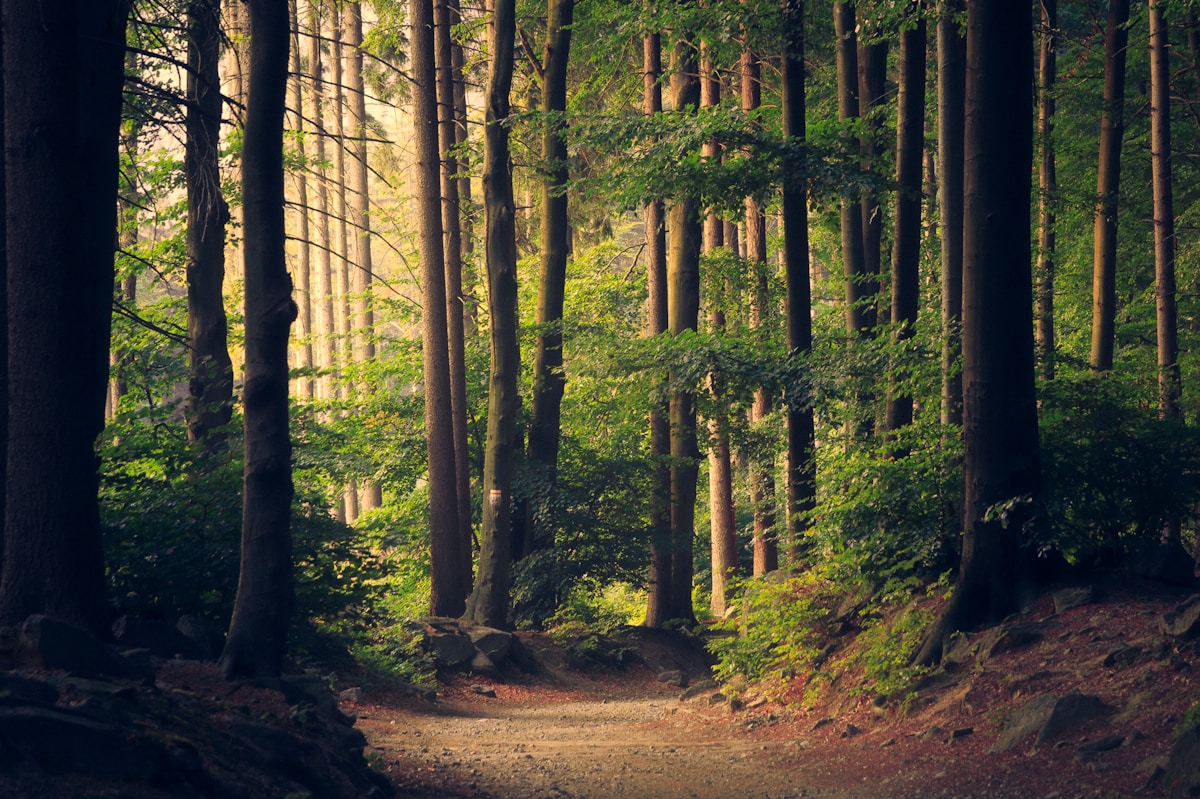
The first thing you notice is not the green. It is the quality of silence. City silence is a vacuum that hums with absence. Forest silence is a texture — layered, alive, composed of the creak of a branch, the skitter of a squirrel, the distant percussion of a woodpecker. You walk slowly, deliberately, at a pace that feels almost disrespectful to a culture that measures time in productivity. Your feet find the soft duff of fallen needles, and your ankles release a tension you have carried since your twenties.
Then the smell arrives. It hits you not as a scent but as a memory you never had. The damp earth, the fungal sweetness of decay, the sharp green of crushed mint underfoot. You breathe in through your nose, hold for a moment, and exhale a sigh that comes from somewhere ancient. Your shoulders drop. Your jaw unclenches. The forest does not ask you to perform. It asks only that you stay.
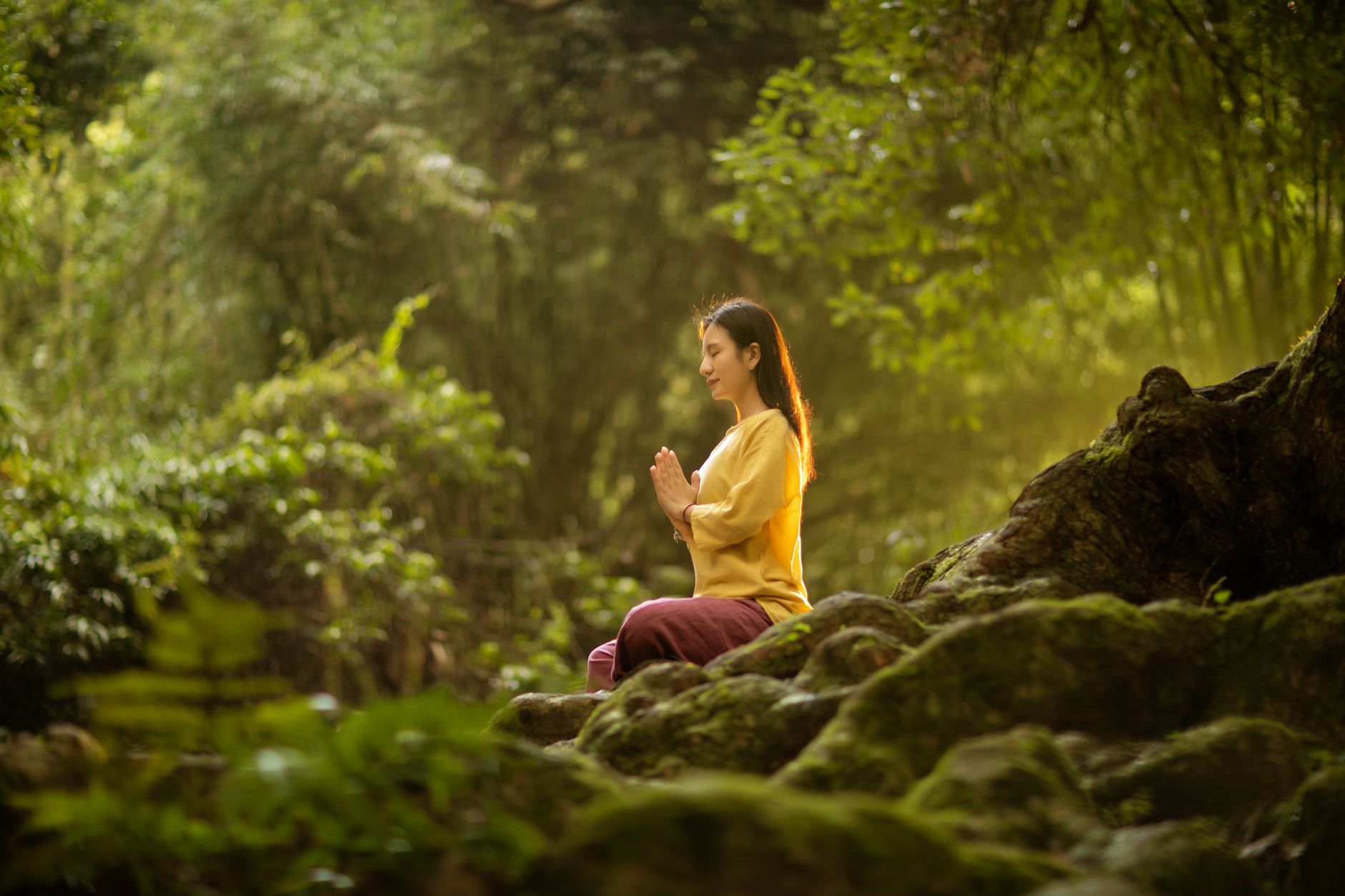
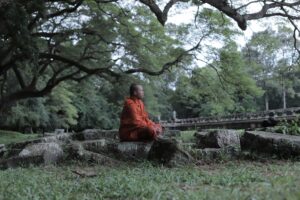
You touch a moss-covered stone. It is cool, slightly damp, rough in a way that feels honest. You look up — really look up — and the canopy fractures into a mosaic of light and shadow. The sun filters through leaves like it is being sieved by a divine hand. You notice your thoughts slowing. Not stopping — that would be too much to ask — but decelerating, like a river meeting a wide, patient plain. You sit on a fallen log. You do not check the time. You do not wonder what you are missing. You are here. That is the entire practice. That is the entire point.
Photo by Rainer Eck on Pexels
Who It’s For
This practice is for the burned-out, the over-stimulated, the ones who measure their worth in unread emails. It is for the traveler who has climbed mountains and collected stamps in passports but still feels hollow — who has seen the Eiffel Tower and the Taj Mahal, yet has never once sat still beneath a single oak and let the minutes pass without purpose.
It serves the person who secretly fears silence. The one who sleeps with podcasts, who queues up audiobooks in the shower, who scrolls during red lights. Forest bathing is not a passive experience; it is an active surrender. You are not watching nature on a screen. You are being watched by it. That shift — from observer to observed — is unsettling at first, and then profoundly liberating.
It is also for the grieving. The forest does not offer platitudes or silver linings. It offers its own cycle: rot becomes soil, soil feeds the sapling, the sapling becomes a grove. There is no rush to feel better here. The trees take centuries. They will wait for you.
Who It’s NOT For
Honest boundary: this is not for the thrill-seeker.
If you need a summit, a summit will disappoint you. Forest bathing is flat. It is slow. It produces no adrenaline, no dramatic vistas, no bragging rights. The Instagram photo of a misty forest floor is lovely, but the experience itself is interior — impossible to capture, impossible to prove. If you measure a trip by the number of miles hiked or the altitude gained, you will find this practice boring, even maddening.
It is also not for the person seeking escape from themselves. The forest is a mirror, not a curtain. In the absence of notifications and noise, your own thoughts will surface — the unpaid bills, the unresolved argument, the quiet dread you have been outrunning. Forest bathing does not make those disappear. It simply gives you the space to sit with them, and in that sitting, something shifts. If you are not ready for that encounter, you will find the silence oppressive rather than healing. That is not a failure of the practice. It is a sign of where you stand.
A Profound Insight
The forest does not try to be anything. It does not strive for better leaf production or faster root growth. It simply is — in full, unapologetic presence. And here is the counter-intuitive truth: the more you try to absorb its benefits, the less you receive.
Effort is the enemy of immersion. When you walk into the woods with a checklist — breathe deeply, touch five textures, notice three sounds — you have turned a sacrament into a spreadsheet. The forest rewards the ones who abandon intention. The healing comes not from what you do, but from what you stop doing. You stop striving. You stop optimizing. You stop treating your own body as a project to be improved. In that stopping, the phytoncides do their quiet work, the nervous system recalibrates, and you remember what you knew as a child: that you are not separate from this world. You are made of the same soil, the same rain, the same patient green.
Carry this home with you: the forest does not need you to fix it. And you do not need to fix yourself. You need only to return — to the trees, to your breath, to the unhurried rhythm of a life that does not require your constant management. What would it feel like to walk through your own city street with that same non-striving attention? To treat a sidewalk tree as a cathedral? To let one ordinary afternoon become a forest bathing session, not because you are in the woods, but because you have finally arrived in your own body?
Conclusion
Forest bathing is not a destination; it is a homecoming. The tradition is ancient, the science is modern, and the practice is deceptively simple — you walk slowly, you breathe deeply, you let the green world have its way with you. The traveler who returns from such a journey brings no souvenirs, no photographs that capture the essence, no stories that translate well at dinner parties. They bring something quieter: a lowered resting heart rate, a softened gaze, a willingness to sit in silence without reaching for a screen. The forest will not miss you when you leave. It has been patient for millennia. But it will remember you — not your name, not your face, but the way you paused. The way you bowed your head beneath its canopy. The way you finally stopped, and let the world, for one precious hour, stop with you.
“`