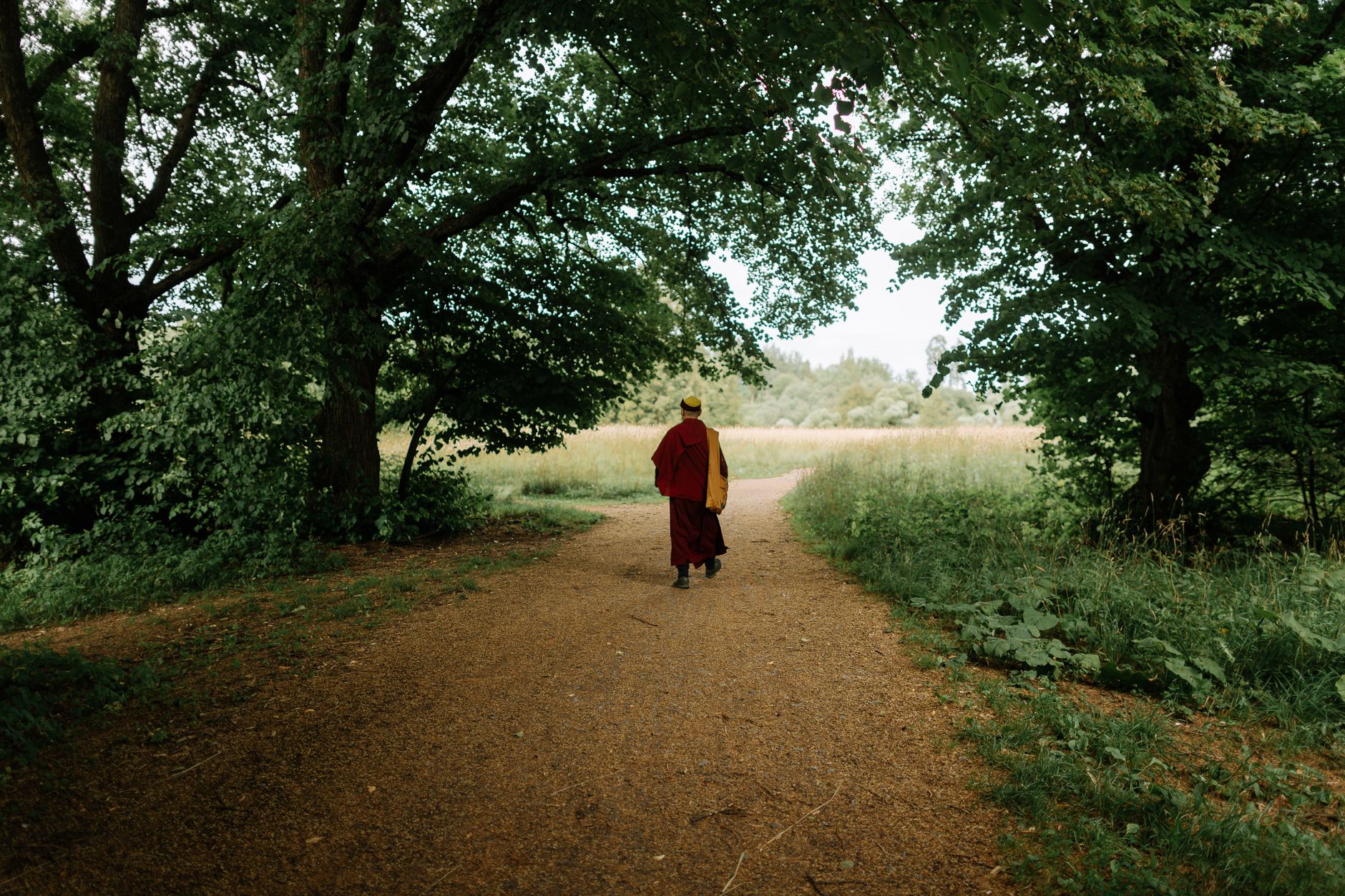
The gravel was still cold from the night when I began walking the outer circuit of the old stupa. Mist hung low over the fields. A single bell sounded somewhere behind me, then nothing but the crunch of my own steps. I had walked this path a dozen times before, always with a camera, always with a plan. That morning I left both behind. What followed was not exercise, and not pilgrimage in any formal sense. Something quieter. A practice of returning to the body, one footfall at a time.
“Walk as if you are kissing the earth with your feet.” — Thich Nhat Hanh
Historical Context
Mindful walking is no modern invention dressed in retreat-center language. It ranks among the oldest contemplative practices we have record of. In the Satipaṭṭhāna Sutta, the Buddha’s own instructions include a section on clear comprehension of walking: knowing when you are walking, where you are going, and what is happening in the body as you move. The practice traveled with monastic communities across Asia, from the forest monasteries of Thailand to the cliffside paths of Tibetan pilgrimage routes. Monks walked in slow, deliberate circuits as a counterweight to long hours of seated meditation, treating each step as a field of attention.
Japan gave the same impulse a different form. Pilgrims on the Shikoku circuit, walking to eighty-eight temples, carried the practice in their bodies over hundreds of kilometers. The poet Bashō walked the narrow roads of the north with nothing but a staff and a notebook, turning each step into a line. Europe’s Christian tradition gave us the labyrinth and the long pilgrimage to Santiago de Compostela, where walking became prayer without words. And in the Islamic world, the circumambulation of the Kaaba, the tawaf, folds movement into devotion in a way that predates most of our travel writing by centuries.

What unites these traditions is a shared understanding: the body is not an obstacle to contemplation. It is the doorway. You do not need a temple to practice. A gravel path will do.
The Experience
The first ten minutes are almost always restless. The mind wants to inventory everything. The ache in the left hip. The list of calls to return. The strange urge to check the time. This is normal, and it is not failure. The practice begins precisely here, with noticing the restlessness without obeying it.
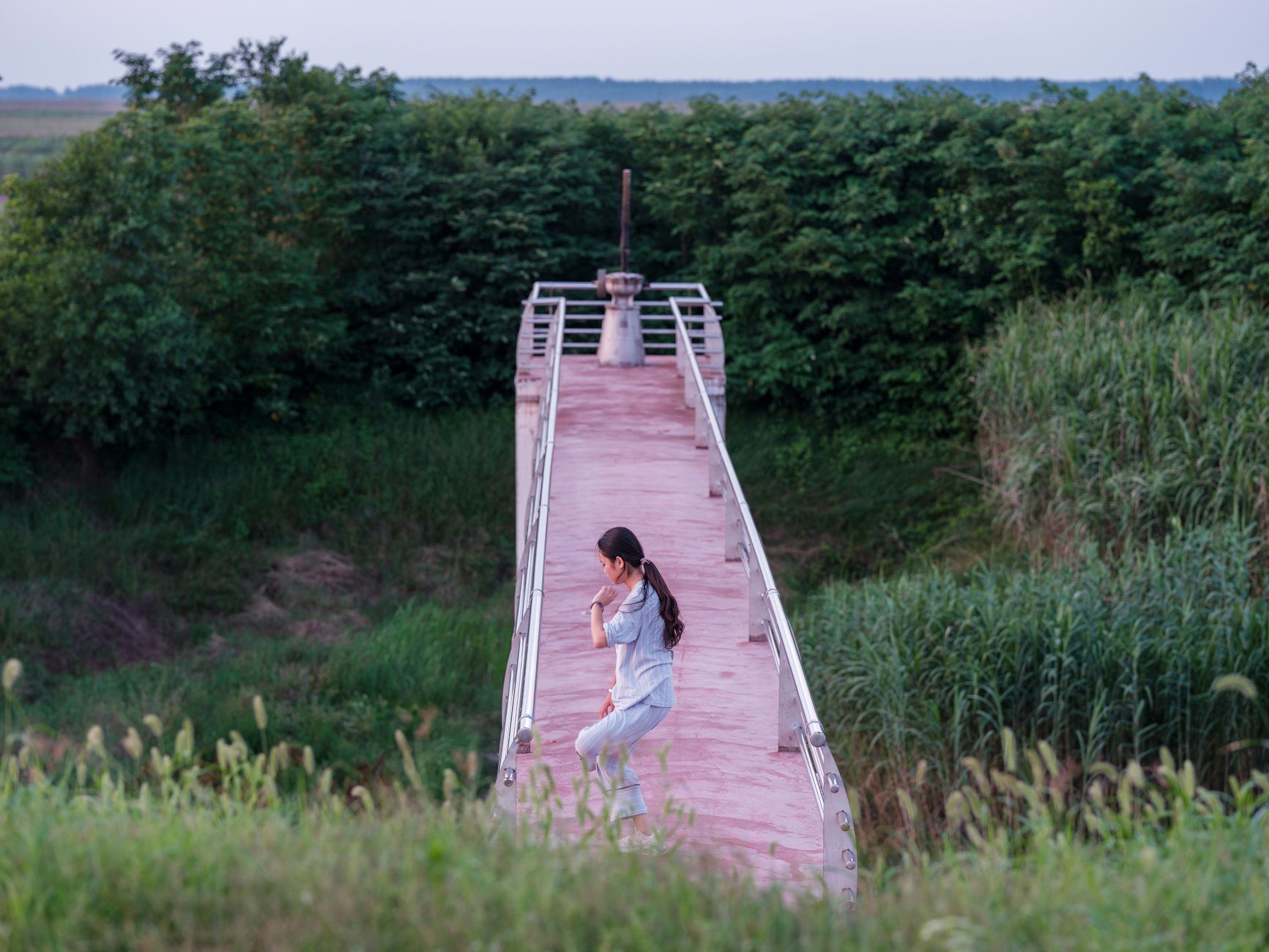
Then something loosens. The breath finds a rhythm with the steps. You begin to feel the sole of the foot meeting the ground — heel first, then the roll through the arch, then the push off the toes. The ground pushes back. A conversation is happening between your body and the earth, and once you notice it, you cannot un-notice it.
On the path around the stupa, the sensory details arrived in a slow procession. Prayer flags snapped in a wind I could not feel at ground level. A dog slept in a patch of sun and did not lift its head as I passed. Somewhere a woman was sweeping with a broom of bound twigs, and the sound was rhythmic, almost musical. My shoulders dropped maybe two centimeters. I did not decide to relax them. The walking did it.
Here is the strange gift of slow movement. It does not demand that you empty your mind. It simply gives the mind a smaller, gentler thing to hold. The breath. The foot. The next step. And when attention wanders — and it will, dozens of times — you return. Each return is the practice. Not the staying. The returning.
By the third circuit, I had stopped counting. The path had become a place rather than a distance to cover. This is the shift that matters. Walking mindfully is not about arriving somewhere. It is about discovering that you were already there.
Who It’s For
This practice serves the traveler who suspects that the pace of their itinerary has quietly become a way of avoiding something. The one who has photographed a hundred sunsets and remembers none of them. Mindful walking offers a different economy. Fewer places, deeper attention.
It suits people in transition — after a loss, a move, a long illness, or simply a season when the old rhythms stopped working. Walking gives the body something to do while the heart catches up. It suits the restless, too. I have taught this practice to people who cannot sit still for five minutes on a cushion and who walk for an hour without complaint. Movement is their doorway.
It also suits the traveler who wants to meet a place on foot rather than through a windshield. A neighborhood reveals itself differently at three kilometers an hour. A church you would have driven past becomes a place where you stop, breathe, and notice the worn stone at the threshold. The destination matters less than the quality of the arriving.
And it suits anyone who has grown tired of the pressure to be productive, even on vacation. Mindful walking is gloriously unproductive. You will have nothing to show for it. That is the point.
Who It’s NOT For
Let me be honest about the boundary. This practice is not for the traveler who needs to cover ground. If your trip is a two-week sprint through five countries, mindful walking will feel like a delay, and you will resent it. That is not a moral failing. It is a mismatch of purpose, and it is worth naming.
Nor is it for someone in acute crisis who needs professional care, not a contemplative technique. Walking can support recovery; it cannot replace treatment. And it is not for the traveler who wants a performance of wellness — the perfectly curated sunrise photo, the caption about presence. That approach will hollow the practice out. The walking does not care about your audience.
One more honest note. Some people simply find walking meditation frustrating. They try it, feel nothing, and conclude they are doing it wrong. If you are among them, sit down instead. The tradition has room for both. The point is not the walking. The point is the attention.
A Profound Insight
Here is the idea I carry home with me, the one that has outlasted every photograph: the destination is not ahead of you. It is beneath you, in the contact between foot and ground. Most of us walk as if the place we are going is where the living happens, and the walking is merely transport. The old traditions say the opposite. The step is the place. The path is the arrival.
This runs against nearly everything our travel culture teaches. We plan, we optimize, we rate the view at the overlook. But the pilgrims on Shikoku did not walk to earn the temples. The walking was the practice, and the temples were where it paused. Bashō did not travel to write about destinations. He traveled to notice. When you understand this, your whole relationship to movement changes. You stop trying to get somewhere and start being somewhere. The path stops being a means and becomes a place.
So here is my counter-intuitive opinion, offered gently: slow down less than you think you should. The internet is full of advice to walk at a glacial pace, to take one step per breath, to make every footfall a ceremony. For most people, that produces self-consciousness, not presence. Walk at a natural pace. Let the rhythm find itself. Attention is the practice, not velocity. A brisk walk with a quiet mind is worth more than an agonizing crawl with a busy one.
What to carry home, then? Not a technique, exactly. A question. Where am I right now, in this body, on this ground? Ask it on the subway platform. Ask it in the airport corridor. Ask it on the walk from your front door to the car. The practice does not require a sacred path. It requires only that you show up on the one you are already walking.
If you want to begin, keep it simple. These four anchors have served me well across many paths and many countries:
- Start where you are. No pilgrimage required. A park, a sidewalk, a hotel corridor at dawn. The ground beneath you is enough.
- Feel the contact. Heel, arch, toes. Let the foot report back. This single sensation is a doorway to the present.
- Return without judgment. Attention will wander. That is not a failure. Each return is the practice, and there is no limit to how many times you may return.
- Walk at your natural pace. Presence is not slowness. Let the rhythm be yours, and let the mind grow quiet around it.
- End with a pause. Before you step back into the day, stop. Breathe. Notice what changed, even if the change is small.
The gravel path around the stupa is a long way from wherever you are reading this. But the practice does not require the stupa, or the mist, or the bell. It requires a body and a willingness to pay attention. I walked three circuits that morning and learned nothing new. I simply remembered something old. The ground has been waiting for me the whole time. It is waiting for you too.