The first time I walked through the gates of Wat Pho, the city did not disappear. Bangkok kept humming — motorbikes, hawkers, the sweet smell of grilled bananas — and yet something shifted. The noise folded itself into a quieter register. I stood beneath the Reclining Buddha, its gold-leafed body stretching forty-six meters, and noticed that no one was rushing. Not the monks. Not the tourists. Not even the pigeons. Thailand’s temples do not demand your silence. They invite it, patiently, the way a good teacher waits for a restless student to settle. That invitation is the real journey, and it begins long before you step onto sacred ground.
Arrive with your questions. Leave with fewer answers and a softer heart.
Historical Context
Buddhism arrived in Thailand — then part of the Mon and Khmer worlds — roughly two thousand years ago, carried along trade routes from India and Sri Lanka. Theravada Buddhism took root here in a way it did not elsewhere in Southeast Asia, shaping not just religion but kingship, law, art, and the rhythm of daily life. Thai temples, or wats, became more than places of worship. They were schools, hospitals, community centers, and libraries.
Temple building reached its golden age during the Ayutthaya period, from the fourteenth to the eighteenth century, when architects perfected the soaring prang and the graceful ubosot. When Ayutthaya fell to Burmese armies in 1767, the capital moved south to Bangkok, and the Chakri kings rebuilt the spiritual heart of the nation. Rama I commissioned Wat Pho. Rama III turned it into a center of learning, inscribing medical and yogic knowledge onto stone tablets that visitors still study today. Rama IV spent twenty-seven years as a monk before taking the throne, then reformed the sangha and brought a scholarly rigor to Thai Buddhism that endures.
What strikes me most is this: Thai temples were never built to impress foreigners. They were built to hold a community’s devotion, generation after generation. The gold leaf is not decoration. It is offering. The towering chedis are not monuments. They are reliquaries, holding fragments of the Buddha’s teachings in physical form. Every curve, every tier, every serpentine naga on a staircase carries meaning. To walk through a wat is to walk through a cosmology made visible.
The Experience
You take off your shoes. That is the first instruction, and it matters more than you expect. Bare feet on warm stone, on cool marble, on the swept earth of a courtyard — the body registers the transition before the mind does. Your pace slows. Your shoulders drop. The world outside the wall grows distant.
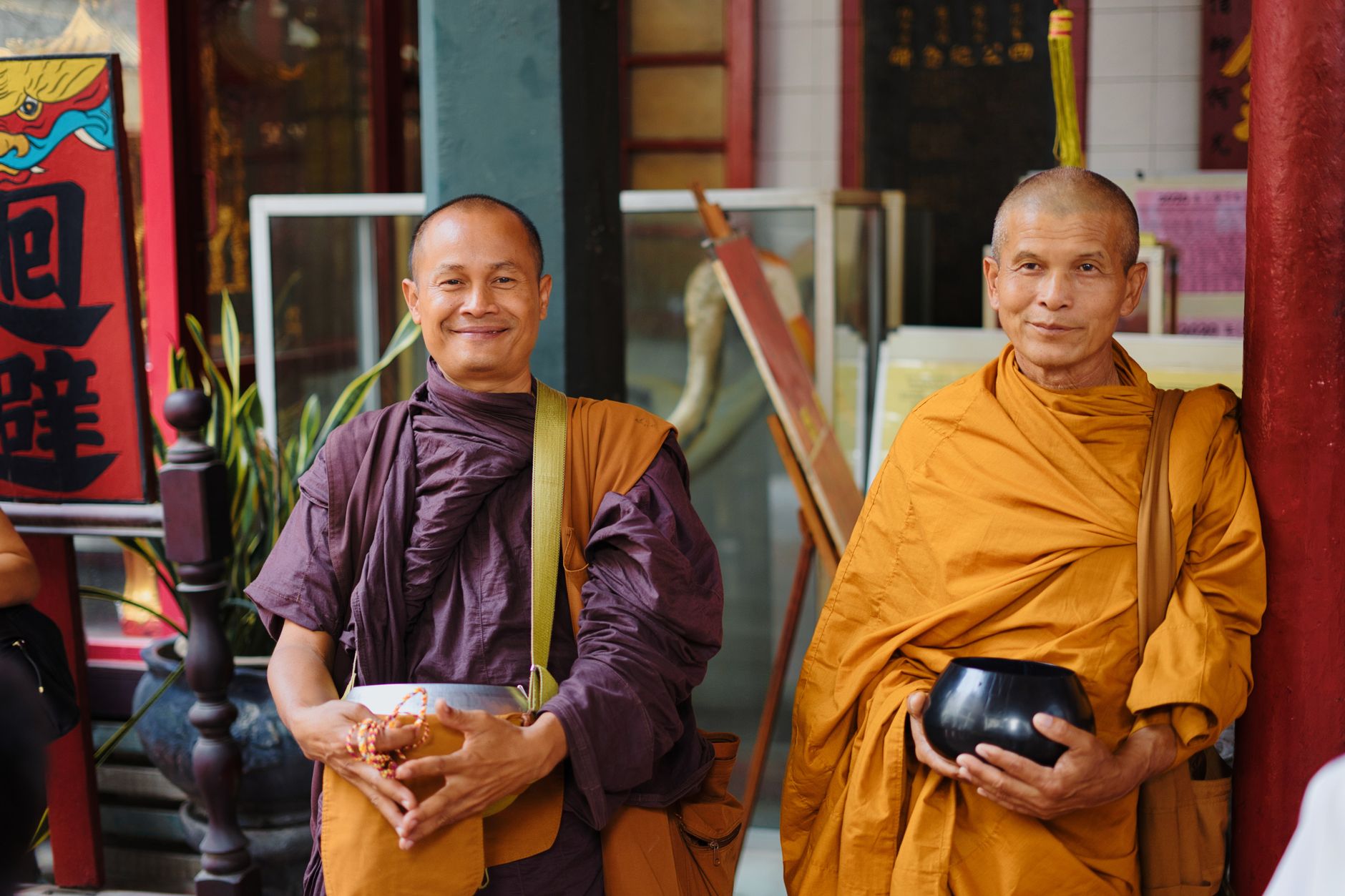
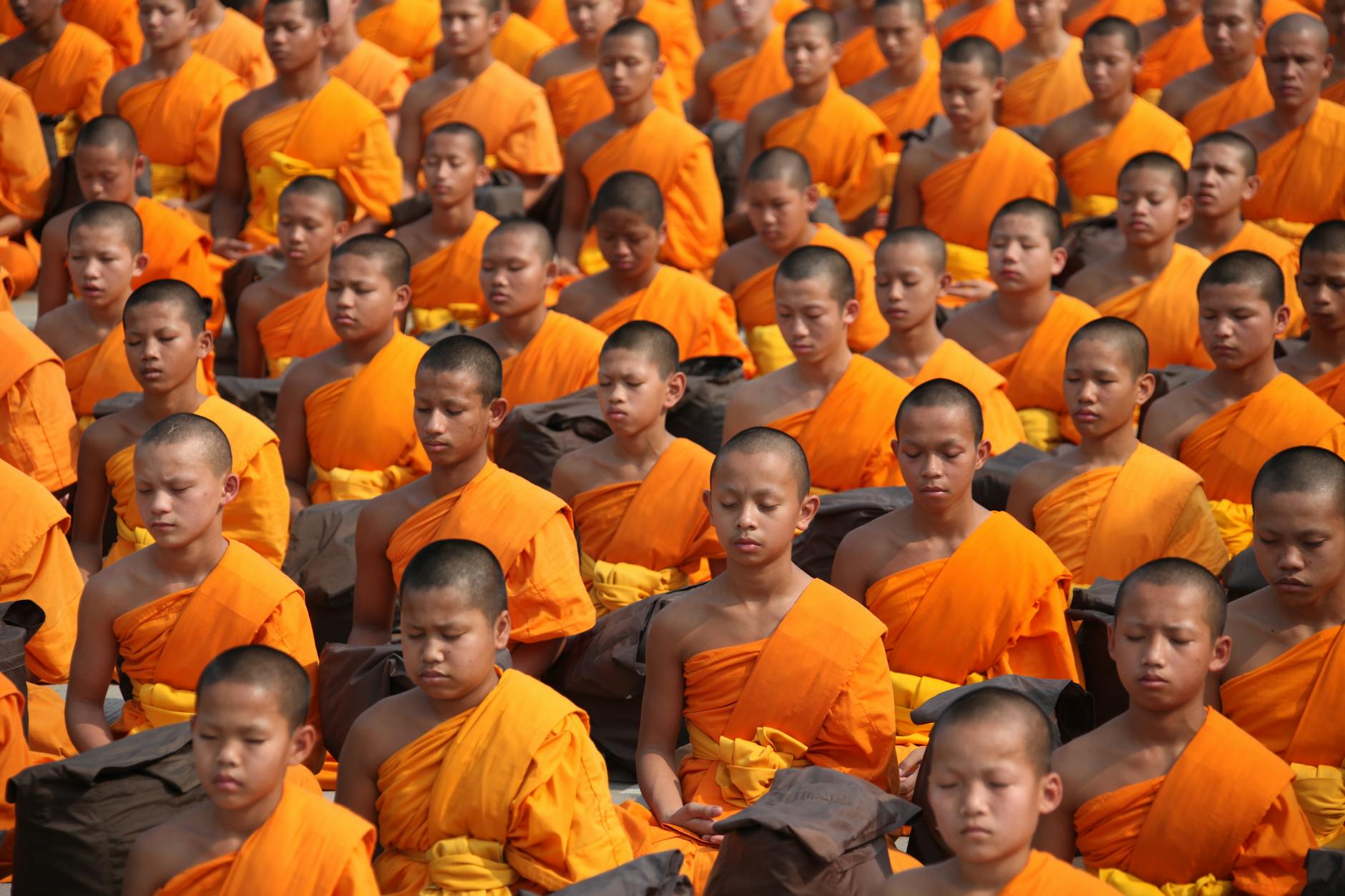
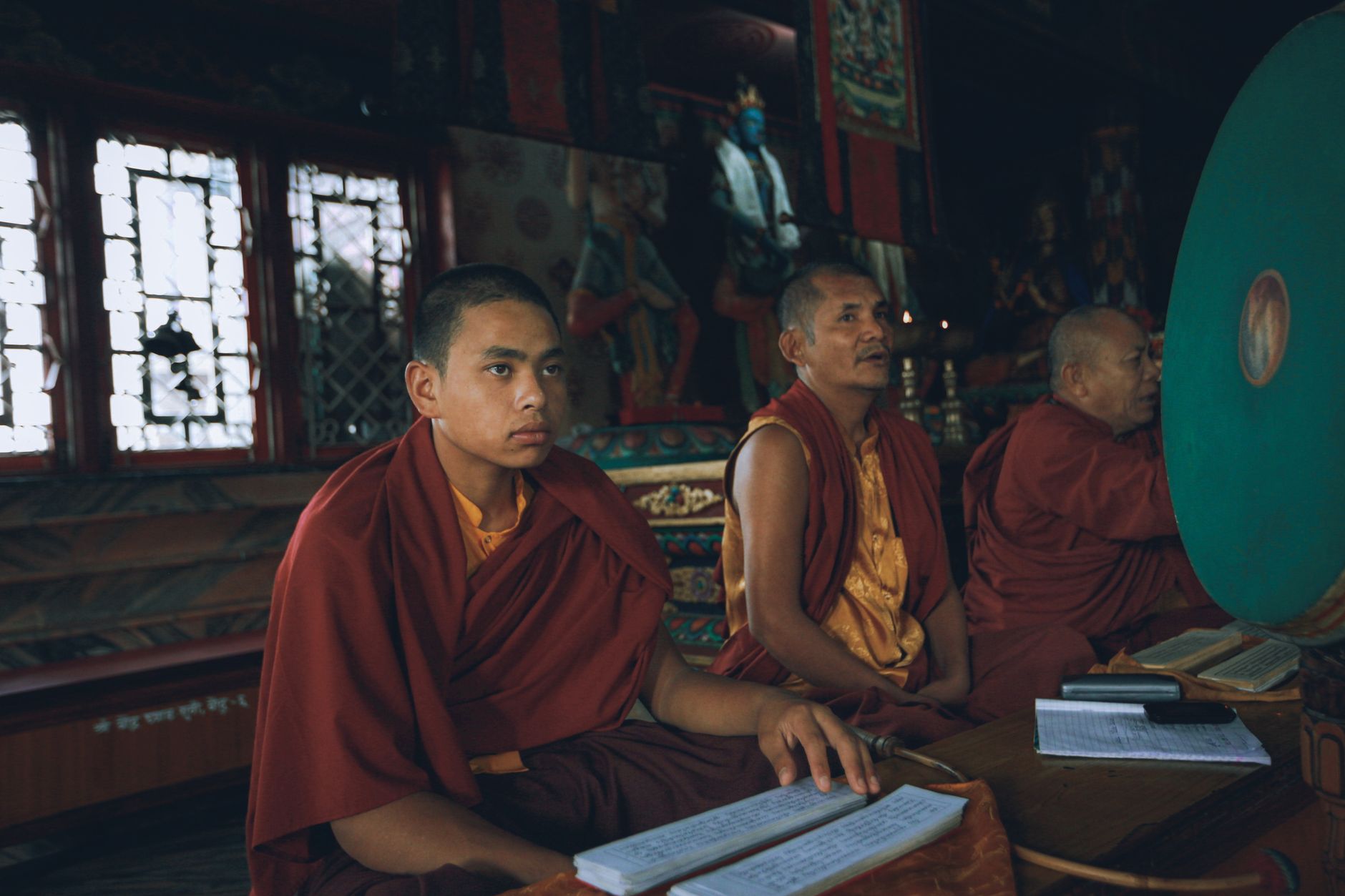
Inside the ubosot, the ordination hall, the air is thick with incense and the low murmur of chanting. Monks in saffron robes sit cross-legged on raised platforms. Their voices rise and fall in Pali, a language no one in the room speaks conversationally, and yet the sound lands somewhere deep. Candles flicker. A woman kneels before a Buddha image, pressing three sticks of incense between her palms. She does not look at anyone. She is not performing. She is speaking to something only she can see.
The sensory details stay with you. The particular sweetness of jasmine garlands sold at the gate. Sunlight falling through a narrow window, catching the gold on a thousand tiny mirrors embedded in a mosaic wall. The soft clink of coins dropping into a donation box. The smell of rice cooking somewhere behind the monks’ quarters. The heat — always the heat — pressing against your skin until you find shade beneath a bodhi tree and understand why the Buddha chose one for his awakening.
And then there is the silence. Not the absence of sound, but a different quality of listening. You hear your own breath. You hear the far-off drone of a tuk-tuk and it does not bother you. You hear the creak of old wood, the rustle of robes, the small sounds that ordinary life drowns out. That silence is the real architecture of a Thai temple. Everything else — the gold, the mosaic, the towering chedi — is built to protect it.
Who It’s For
This journey belongs to the traveler who is willing to be still. Not the one who wants to check off temples like museum exhibits, but the one who will sit on a stone step for twenty minutes and do nothing. It serves the seeker who understands that sacred places are not performances. It serves the walker who is happy to leave the guidebook in the guesthouse and follow their feet.
It is for the person who has grown tired of rushing. For the one who suspects that the most important part of any trip is not what they see but who they become while seeing it. For the traveler who will remove their shoes without being asked, who will lower their voice without being told, who will bow slightly to a monk and mean it.
Thailand’s temples welcome everyone. But they reward a particular kind of attention. If you can bring curiosity without entitlement, patience without agenda, and a willingness to be a guest rather than a consumer, these places will open themselves to you in ways that cannot be scheduled.
Who It’s NOT For
This is not for the traveler who needs constant stimulation. If your ideal day involves a packed itinerary, a checklist of must-see sites, and a photo at every stop, the slow rhythm of temple life will frustrate you. There is no queue for enlightenment. There is no shortcut to stillness.
It is also not for the person who treats sacred spaces as backdrops. A temple is not a stage for your Instagram story. It is a living place of worship, and the people praying beside you are not extras in your travel narrative. If you cannot put your phone away, if you cannot dress modestly without resentment, if you cannot accept that some spaces are closed to you because you are not a monk or because you are not a man or because you are not Thai — then this is not your path. And that is not a judgment. It is simply a boundary that deserves your respect.
Finally, it is not for the traveler who wants guarantees. You may visit ten temples and feel nothing. You may sit in meditation for an hour and find only restlessness. The sacred does not perform on command. It arrives when it arrives, and often in the most ordinary moment — a child laughing in a courtyard, a cat sleeping on a warm step, the sudden smell of rain on hot stone.
A Profound Insight
Here is the counter-intuitive truth I have carried home from every temple I have visited in Thailand: the gold is not the point. The gold is a finger pointing at the moon. The real teaching is in the emptying — the way you take off your shoes, the way you leave your ego at the gate, the way you bow before something larger than yourself.
We are trained to accumulate. More experiences. More photos. More proof that we were there. But a temple asks the opposite. It asks you to subtract. To remove your shoes, your hat, your sunglasses, your need to be seen. To stand barefoot on ground that has held the prayers of a thousand years. To remember that you are small, and that this smallness is not an insult. It is a relief.
The profound insight is not something you learn. It is something you remember. You already knew how to be still. You already knew how to listen. You already knew that the most important moments of your life were not the ones you documented but the ones you felt. The temple does not give you anything new. It simply removes the noise so you can hear what was always there.
Key Takeaways for the Mindful Traveler
- Dress modestly — cover shoulders and knees, remove shoes before entering any temple building, and always step over the threshold, never on it.
- Sit with one temple rather than rushing through many. Depth rewards more than breadth.
- Learn three phrases in Thai: sawasdee (hello), khop khun (thank you), and mai pen rai (it’s okay, never mind). That last one is a philosophy.
- Follow the local rhythm. If monks are chanting, listen. If a courtyard is empty, sit. If a sign says closed, do not peek.
- Leave your phone in your bag. If you must photograph, do it after you have simply looked for a full minute.
- Give something back — a small donation, a quiet hour of volunteering, or simply your full attention. The temple asks for nothing, which is exactly why you should offer.
Thailand’s temples are not destinations. They are doorways. You do not complete them. You pass through them, changed in ways you may not notice until months later, when you find yourself standing barefoot in your own kitchen, breathing slowly, remembering the silence. The journey does not end when you leave. It begins when you return, carrying that stillness like a small flame cupped in your hands. Go gently. Go curious. And when you arrive, take off your shoes.
