Somewhere between the last switchback and the tree line, the mind stops narrating. You don’t seek this. It arrives — quiet, unannounced, like a deer stepping onto the path ahead. This is the invitation of meditating with nature: not to conquer a summit or collect a view, but to let the wild world teach you how to be still inside your own skin. The mountains do not hurry. The river does not rehearse. Sit among them long enough, and something in you remembers a rhythm older than calendars.
“The forest is not a resource. It is a presence — and presence is the only teacher worth following.”
Historical Context
Long before meditation was packaged into apps and studio memberships, it lived outdoors. The Buddha attained awakening beneath a bodhi tree, not in a temple. The desert fathers of early Christianity withdrew to the Egyptian wilderness to pray in silence. Japanese monks walked the cedar paths of Mount Kōya for centuries, treating each step as a mantra. In the yogic tradition I inherited, the rishis of the Himalayas sat by glacial streams and let the sound of moving water replace the chatter of the mind.
What unites these traditions is not doctrine. It is geography. Each one understood that the natural world holds a frequency the human nervous system can attune to — if we stop long enough to listen. The Celts spoke of “thin places,” landscapes where the veil between the ordinary and the sacred grows translucent. The Aboriginal peoples of Australia mapped songlines across the continent, walking meditation routes older than any scripture. None of this is metaphor. It is memory, passed body to body, breath to breath.

Modern travel has largely severed this inheritance. We fly to a national park, photograph the sunrise, and drive to the next viewpoint. The ancients would find this baffling. To them, a mountain was not a backdrop but a companion. The question was never how fast you could reach the peak, but how deeply you could dwell at its base.
The Experience
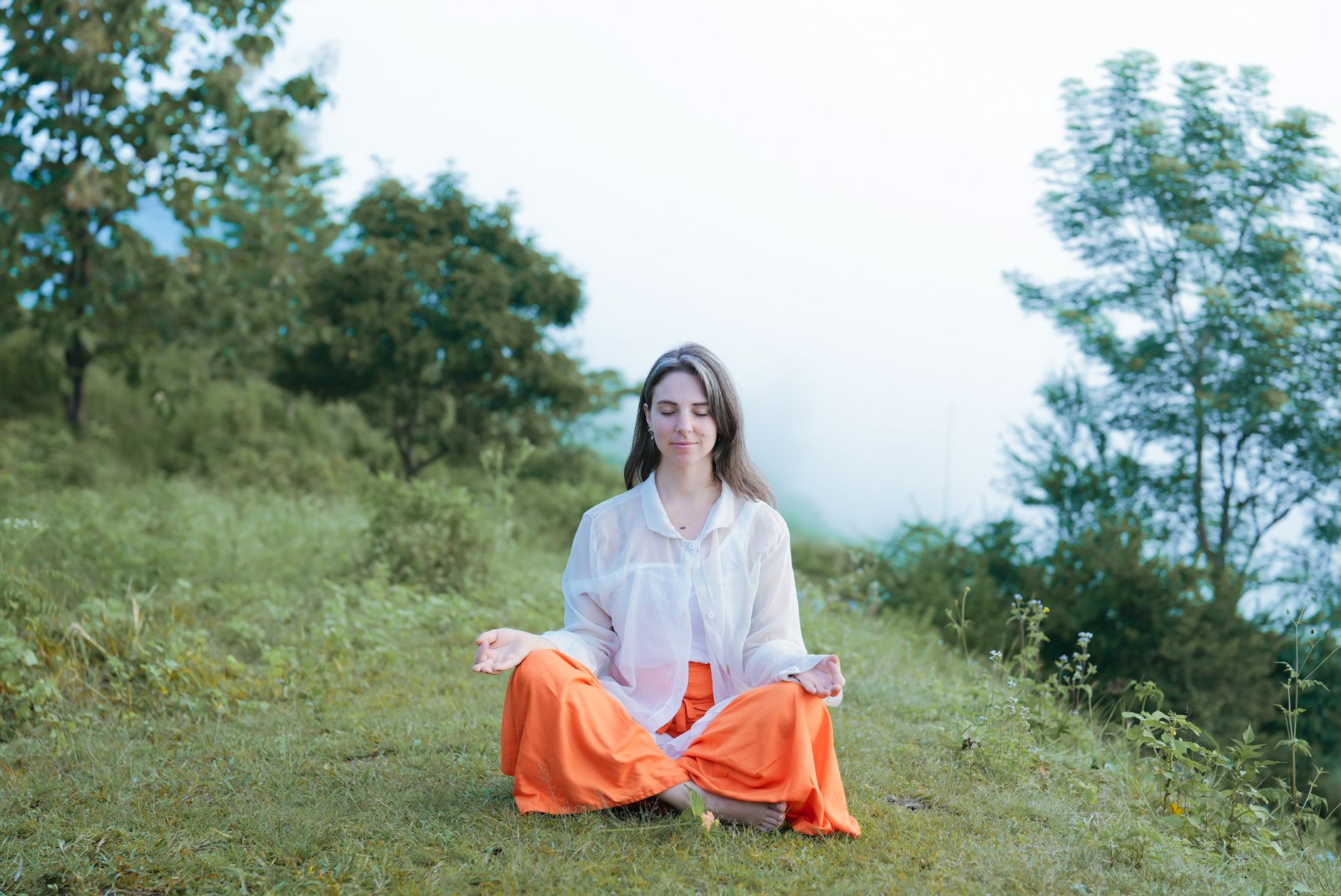
Choose a place that asks nothing of you. A mossy boulder beside a creek. A dune that catches the late afternoon light. The edge of a meadow where the grass grows tall enough to hide a fox. Sit down. Let the ground take your weight fully — not the polite half-sit we offer chairs, but the complete surrender of hips to earth.
At first, the senses flood. The air smells of wet bark and crushed pine. A breeze crosses your left cheek, then your right. Somewhere behind you, a bird repeats a three-note phrase, patient as a teacher. Your mind, trained by years of screens, will try to name everything. That’s a juniper. That’s a chickadee. That’s a cloud shaped like a hand. Let it. Naming is how the mind makes friends with the unfamiliar.
Then, slowly, the naming subsides. What remains is sensation without label. The pulse in your fingertips. The slight chill where sweat dried on your neck. The way your breath grows longer, as if the trees are breathing through you. I have sat in redwood groves where time lost its edges entirely — where a single hour felt like a single exhale. I have also sat in high desert where the silence was so complete it had texture, like velvet pressed against the ears.
Here is what no one tells you: nature does not calm you. It reveals you. The agitation you carried up the trail does not vanish — it becomes visible. You see your impatience in the way you check your phone. You feel your grief in the tightness behind your sternum. The forest does not fix this. It simply holds it, the way a grandmother holds a crying child, without commentary, without hurry. And in that holding, something loosens.
This is not a performance. You will not levitate. You will likely get cold. A mosquito will find the one patch of skin you missed. These are not interruptions. They are the practice.

Who It’s For
This practice belongs to the traveller who is tired of accumulating experiences and hungry for depth. The one who has stood at enough overlooks to know that a photograph is not the same as a feeling. The one who suspects that the most radical act of our age is to sit still in a wild place and do absolutely nothing productive.
It serves the grieving, the burned-out, the quietly lost. It serves anyone who has ever walked into a forest and felt, against all logic, that they were being greeted. It serves the solo traveller who wants company that does not speak English. It serves the parent who has forgotten what their own mind sounds like without a child’s needs layered over it. It serves the seeker who has tried every meditation app and found them hollow — because the voice guiding them was recorded in a studio, not sung by a canyon wren.
And it serves the reluctant. The one who thinks they are too restless, too skeptical, too urban for this. Especially them. The forest has no prerequisites.
Who It’s NOT For
Let me be honest, because the wellness industry rarely is. This practice is not for the traveller seeking a curated experience with a guide, a schedule, and a post-meditation brunch. It is not for those who need to be entertained, who measure a day by how many landmarks they ticked off, or who feel genuine distress in silence. That is not a moral failing. It is simply a different temperament, and there are beautiful ways to travel that honor it.
It is also not for anyone in acute crisis. If you are in the grip of a panic attack, severe depression, or active trauma, sitting alone in a remote place is not medicine — it can be dangerous. The wilderness amplifies whatever you bring. For some, that amplification is healing. For others, it is overwhelming. Seek a therapist, a trusted friend, a guided retreat with trained facilitators. The forest will still be here when you are ready.
And it is not for those who cannot sit with discomfort. Cold, damp, insects, the ache of crossed legs, the boredom that arrives like a fog — these are not bugs in the system. They are the system. If you need the experience to be pleasant, you will fight it. And fighting is the one thing that guarantees you will miss it.
A Profound Insight
Here is the counter-intuitive truth I have carried down from a thousand trails: the goal of meditating with nature is not to feel peaceful. It is to feel present — and presence is often uncomfortable. The peace arrives later, as a byproduct, like the smell of woodsmoke in your jacket days after the fire. If you sit down expecting calm, you will spend the whole hour chasing it. If you sit down expecting nothing, you may find that calm sits down beside you, uninvited, and stays longer than you asked.
There is a deeper teaching here, one that has nothing to do with travel. The wild world is not a mirror. It does not reflect your best self back to you. It is a companion — indifferent, ancient, and utterly without agenda. When you learn to sit with something that does not need you, you begin to unlearn the exhausting belief that you must be needed to be worthy. That is the insight worth carrying home. Not the photo. Not the summit. The quiet, radical knowledge that you are not the center of the story — and that this is a relief, not a loss.
- Choose places that ask nothing. Skip the iconic viewpoints. Find a creek bend, a meadow edge, a boulder in the shade. The less dramatic the setting, the deeper the sitting.
- Sit for at least twenty minutes. The first ten will be noise. The second ten are where the practice begins. Bring a cushion or folded jacket — comfort supports stillness.
- Let the senses lead. Name what you hear, smell, and feel until the naming falls away on its own. Do not force silence. Receive it.
- Leave your phone in your bag. Not on airplane mode. Not face-down on your knee. In the bag, zipped. The forest cannot teach you if you keep one ear tuned to the world you left.
- Return to the same spot. A relationship with a place deepens like any relationship — through repetition, through seasons, through showing up when you would rather not.
Meditating with nature will not fix you. It will not make you enlightened, or thinner, or more productive. It will do something stranger and more useful: it will remind you that you belong to the living world, not above it. That your breath is the same breath moving through the pines. That stillness is not an achievement but a homecoming.
So find a trail. Find a stone. Sit down. Let the mountain be the teacher, the river be the metronome, the wind be the only voice you need to follow. And when you rise — stiff, cold, a little changed — carry the quiet with you. The world outside the forest is loud. But you will know, now, that the silence is always there. Waiting. Patient as a tree. Ready to receive you again.